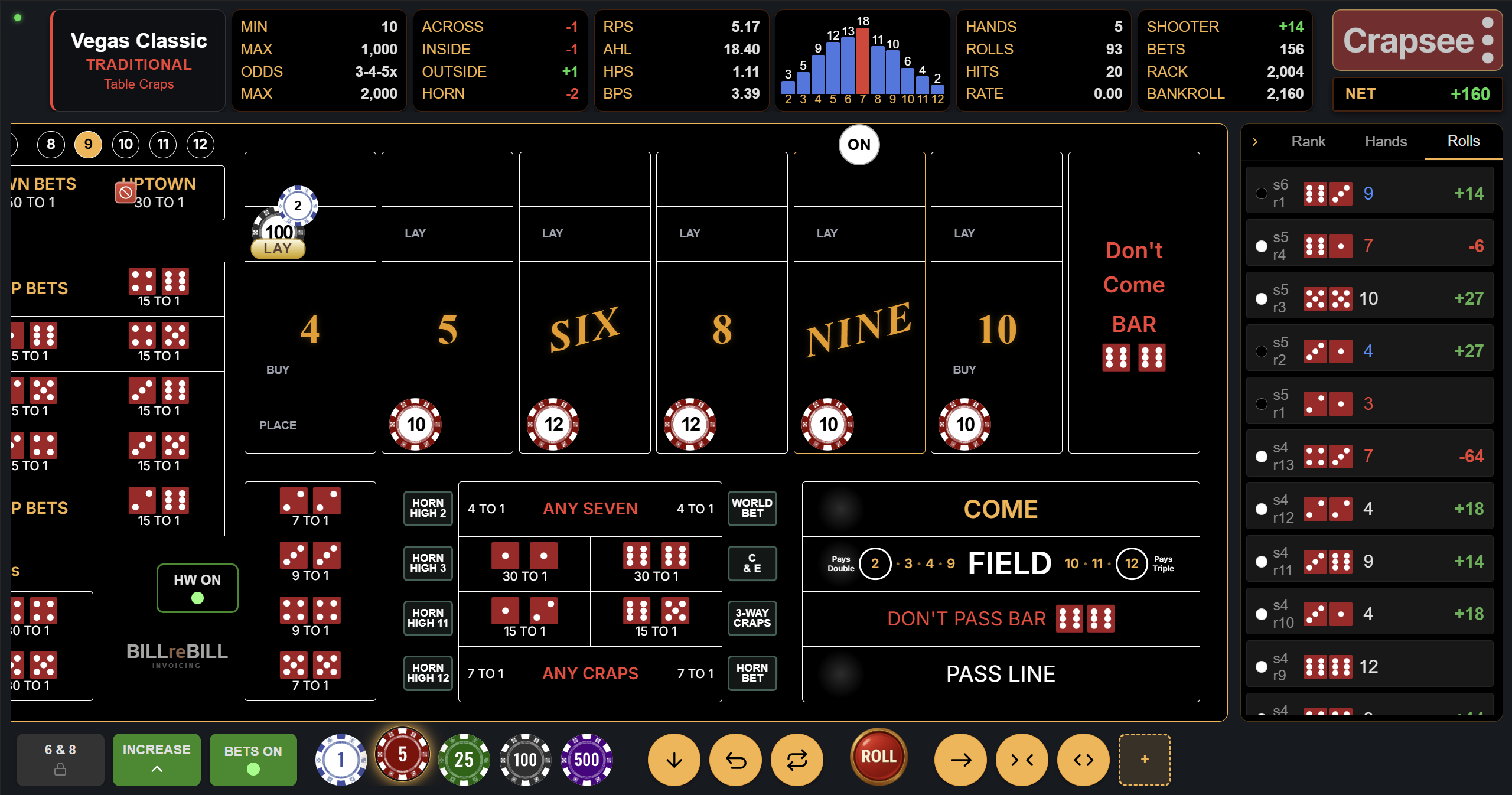
Crapsee is a free online craps simulator built for practice, strategy training, and honest system testing. Cryptographically secure dice. Every casino bet type with accurate payouts. The house edge plays out exactly as the math predicts over thousands of rolls, so what you learn here transfers directly to a real casino table or bubble machine.
Why use a craps simulator?
- Learn bets without losing money. Test every bet type to see how payouts work.
- Validate strategy claims. Run a system for 500+ rolls and see if it actually wins.
- Build muscle memory. The pace and decision flow become automatic before you walk into a casino.
- Measure real variance. Feel what a 1,000-roll session actually looks like.
- Practice bankroll discipline. Hit stop-losses without the emotional cost of real money.
What is a craps simulator?
A craps simulator is a software implementation of casino craps that accurately reproduces the rules, bets, payouts, and house edge of a real table. Good simulators use genuine random number generation so the rolls, over thousands of trials, match the actual probability distribution of fair dice. Practice translates directly to casino play.
A simulator is not the same as a craps "video game" or "arcade game." Those often use simplified rules, non-standard payouts, or tweaked probabilities for entertainment. If a craps software gives you too many wins, the simulator is lying - and your practice is teaching you the wrong math.
Crapsee is a simulator in the strict sense: rolls use the browser cryptographic random number generator, payouts match casino standards, every bet type is implemented, and the backend engine enforces mathematical integrity on every bet resolution.
What makes a real craps simulator (not an arcade game)
Five attributes distinguish an accurate simulator from an entertainment product:
1. Cryptographic random number generation
Real simulators use genuinely random dice - either hardware RNG or a cryptographic pseudo-random function (CSPRNG). These produce rolls that pass statistical randomness tests. Simpler "random" functions in JavaScript (Math.random) are pseudo-random and can sometimes show pattern bias over long runs. Crapsee uses the Web Crypto API.
2. Accurate payouts
Real casino payouts: Pass Line 1-to-1, Place 6/8 7-to-6, Hardway 6/8 9-to-1, Any Seven 4-to-1. A simulator that pays differently is lying about the house edge.
3. Every bet type implemented
A real craps table has 30+ bet types. A simulator missing proposition bets, hop bets, or don't-side bets is incomplete.
4. Honest house edge over long runs
Run a simulator for 10,000 rolls. Pass Line house edge should converge on 1.41%. Place 6/8 on 1.52%. Any Seven on 16.67%. If the observed edge doesn't match, the simulator's RNG is biased.
5. Correct edge case handling
Don't Pass push on 12 (or 2 depending on layout). Odds bets "off" vs "on" during come-out. Come bet movement to point numbers. Odds bets paying at true rates regardless of point. A simulator that skips edge cases will teach you incorrect habits.
Crapsee satisfies all 5 criteria. We built the engine for simulation first, then layered the UI on top - not the other way around.
How to practice craps with a simulator
A structured approach gets more out of a simulator than just clicking Roll for an hour:
Week 1 - One bet at a time
Play Pass Line only for 50 rounds. Feel the rhythm of the come-out, the point round, the seven-out. Next session add Don't Pass. Third session add Come. This builds each mechanic into muscle memory before moving on.
Week 2 - Odds bets
Add single-odds behind Pass Line. Play 100 rounds. Notice that your bankroll variance increases (higher per-round exposure) but your expected loss rate decreases. Then try 3-4-5x odds. See how max odds feels.
Week 3 - Strategy testing
Pick one strategy (the craps strategy guide covers the common ones). Run it for 500 rolls. Track starting and ending bankroll. Compare against theoretical house edge to see if variance went your way or against you that session.
Week 4 - Bad bets
Deliberately bet Any Seven or hardways for 100 rolls. Watch your bankroll drain. Feeling the 11-17% house edge in practice teaches the math better than reading about it. You will never bet proposition bets again after seeing what they cost.
After 4 weeks of structured practice, you will have the understanding most casino regulars take years to build. The simulator is a shortcut, not a substitute.
Test a craps strategy with the simulator
If you found a "winning craps system" online, run it on the simulator before risking real money. The honest dice will show you whether the claim holds up.
The protocol
- Set a fixed starting bankroll (e.g. 500 units).
- Execute the strategy exactly as described. No deviations.
- Run 1,000 rolls.
- Compare ending bankroll to starting bankroll.
- Repeat the full test 5 times.
Expected outcomes by strategy type
- Pass Line with Max Odds: Slight decline over the long run. House edge 0.3-0.4%. A 500-unit bankroll over 1,000 rolls should show small losses on average with occasional positive sessions.
- Iron Cross: Larger decline. Effective edge 1-2%. Losses compound faster than Pass Line.
- Martingale (doubling after losses): Usually catastrophic. One cold streak wipes out the bankroll. The simulator shows why this doesn't work even though it looks like it should.
- "Guaranteed winning" paid systems: Lose at a rate close to the underlying bet's house edge. If the system relies on Field bets, expect ~5% edge. If it relies on hardways, expect ~10%.
No craps strategy wins over the long run against honest dice. The simulator makes this provable. Save the "$500 system" money - run it on Crapsee instead.
Craps trainer - learn one bet at a time
Treat the simulator as a craps trainer. Each session has one focus:
- Session 1: Pass Line only. 50 rounds. Learn come-out vs point round.
- Session 2: Don't Pass only. 50 rounds. Feel the wrong-way perspective.
- Session 3: Pass Line + Odds. Learn odds bet mechanics.
- Session 4: Add Come bets. Learn layered betting.
- Session 5: Place 6 and Place 8 only. Learn box bet mechanics.
- Session 6: Field bet only. Learn single-roll resolution.
- Session 7: Prop bets (Any Seven, Yo, Horn) - just to experience why they are bad.
After 7 sessions (roughly 5-7 hours of simulator time), you will know craps better than 90% of the people sitting at a real table on a weekend night.
Simulator practice vs real casino play
| Aspect | Simulator (Crapsee) | Real casino |
|---|---|---|
| Rules and payouts | Identical | Identical |
| House edge | Identical over long runs | Identical |
| Cost to practice | Free | Real money |
| Pace | 10-30 seconds per round | 2-5 minutes per round |
| Number of rolls per hour | 120+ | ~30 |
| Ability to test every bet | Unlimited | Cost-limited |
| Social factors | None | Crowd, dealers, etiquette |
| Emotional weight | Low | High (real money) |
| Ideal use | Learning, strategy testing, bet mechanics | Experience, entertainment, social play |
A simulator delivers 4x more practice per hour than a live table and at zero cost. What it can't teach is the feel of a hot table, the social rhythm, or how you personally handle real-money variance. Use the simulator first for mechanics; use the live table for atmosphere.
Crapsee simulator features
- Cryptographically secure dice. Browser-native Web Crypto API. Rolls pass statistical randomness tests.
- Every casino bet type. 30+ bets from Pass Line to Hop bets, all with accurate payouts.
- Ghost-chip betting. 0-millisecond visual feedback while the backend engine validates math.
- Both Table and Bubble payout modes. Pair with our bubble craps simulator for full electronic-variant practice.
- Crapless and Easy variants (Enhanced tier) - unlock in plans. Learn more in the dedicated crapless craps simulator guide.
- Mobile-friendly. Any modern browser, any device. The best craps app experience without an App Store install.
- No real money. Simulator only. No deposits, no cash-outs, no risk.
- Persistent state. Close the tab and come back later - your session continues where you left off.
Craps practice and craps demo - what Crapsee offers vs other options
When people search for a craps practice game or a craps demo, they usually mean the same thing: a way to play craps without putting real money on the line. The terminology differs, but the intent is identical - learn the game, test a strategy, or keep the skill sharp between visits to a live table. Crapsee is built for exactly that purpose, and it does not limit how long you can practice or how many rounds you can play.
What "craps demo" usually means elsewhere
Most sites that advertise a craps demo are operating game-launch demos attached to real-money platforms. The demo mode runs for a limited number of rounds, resets when time expires, or locks out certain bet types to push you toward a deposit. The purpose of those demos is conversion, not education. You get 5 minutes of play, then a signup form.
A genuine free craps demo - one that runs forever, covers every bet, and uses honest dice math - is harder to find than it should be. That gap is what Crapsee fills. There is no timer. There is no countdown to a paywall. The free craps table is open as long as you want to practice.
Why craps practice actually matters
Craps has a steeper learning curve than most table games, not because the rules are complicated, but because the table is busy. Fifteen different bet areas, dealers calling results fast, chips moving constantly. Walking in cold and trying to learn at a live table is expensive and stressful.
Structured craps practice on a simulator solves this. You build muscle memory for three things before money is ever at risk:
- Bet timing. Which bets are available on the come-out vs. point round. When to place, when to stay put. On a live table this happens in seconds. On a craps practice game, you can take as long as you need.
- Payout recognition. Knowing a Place 6 pays 7:6 and a Hardway 6 pays 9:1 - not just intellectually but visually, by watching them resolve hundreds of times. That recognition is what separates a confident player from a confused one.
- Strategy rhythm. Running the 3 Point Molly or an Iron Cross is not complicated on paper, but it takes practice to execute without hesitation mid-round. A craps practice game is the only way to build that automaticity before you sit down with real chips.
See the full craps strategy guide for systems worth practicing, and the all craps bets reference for the complete bet library available on every Crapsee table.
How Crapsee compares as a craps practice platform
Crapsee is a dedicated craps practice platform, not a side feature of something else. The distinction matters because the math is built for accuracy, not entertainment. Real casino payouts. Cryptographic dice. Every bet type from Pass Line to hop bets, all with correct house edges.
What you practice here transfers directly. If you spend an hour on a craps practice game that uses fake math or inflated win rates, you are learning the wrong habits. Crapsee's engine is the same one running behind the scenes whether you are using the free table or an Enhanced-tier table with additional variants.
If you are looking for a related starting point, the free craps game page covers the entry-level free play experience, while this page focuses specifically on the simulator's practice and strategy-testing capabilities. They serve different search intents but link to the same underlying table.
Full-featured, permanently free, no signup required
The core craps demo on Crapsee - traditional craps with every bet type - requires no account, no email address, and no payment information. Open the table, start rolling, practice for as long as you need. There is no session timer counting down in the corner.
Enhanced and Premium tiers unlock additional table variants (Crapless, Easy Craps, custom table configurations) and more AI players for social simulation, but the full craps practice experience - Pass Line, odds bets, place bets, come bets, proposition bets, bankroll tracking - is available free from the first click.
If you are ready to stop reading and start practicing, the free craps table is one click away. No timer. No signup. Real dice math.
Frequently asked questions
What is a craps simulator?
Software that reproduces casino craps rules, bets, and payouts with accurate random dice. Used for practice, strategy testing, and training. Different from a craps "game" which may use simplified math for entertainment.
Is Crapsee a real craps simulator?
Yes. Cryptographic dice (browser Web Crypto API), accurate casino payouts, every bet type, backend-validated math. House edge plays out exactly as the math predicts over thousands of rolls.
What is the difference between a craps simulator and a craps game?
Simulator prioritizes math accuracy - rolls match real probability distributions, payouts match casino rates. Game may prioritize entertainment - easier wins, simplified bets. For practice that transfers, you need a simulator.
Can I practice craps strategy with a simulator?
Yes. Run any strategy over hundreds or thousands of rolls with honest dice to see how it actually performs against real variance. No strategy wins over the long run against fair math - the simulator makes this provable.
Is the Crapsee craps simulator free?
Yes. Traditional craps and Bubble Craps are free with no signup. Crapless Craps and Easy Craps are in Enhanced tier.
How is Crapsee different from other free craps simulators?
Cryptographic dice instead of pseudo-random, complete bet coverage including hop bets and don't-side, 0-ms ghost-chip feedback, and backend-validated math. Built as a simulator first, not a game with simulator branding.
Can I test a craps betting system with the simulator?
Yes, and you should before risking money. Most "winning systems" fail over 1,000+ rolls against honest dice. Run your system on Crapsee to validate or debunk it.
Does practicing on a craps simulator help at a live casino?
Yes for mechanics and discipline - bet timing, payout recognition, bankroll management. No for social factors - crowd, dealers, and live pace need real experience.
Can I use a craps simulator to count or predict rolls?
No. Dice are independent random events. No pattern prediction is possible regardless of platform. The simulator reinforces this by making it easy to try and fail.
Can I play the simulator on mobile?
Yes. Any modern mobile browser on iOS or Android. No app required. Add to home screen for quick access.
What is a craps demo?
A craps demo is a free, no-money version of the game used for practice or preview. On most real-money platforms, a demo mode is time-limited and exists to encourage deposits. On Crapsee, the craps demo is the entire product - unlimited rounds, every bet type, accurate casino math, no timer, no signup required. It is a full craps practice environment, not a promotional teaser.
How do I practice craps without losing money?
Use a free craps simulator like Crapsee. Open the free craps table, set a starting bankroll, and play exactly as you would at a live casino - but with no real money at risk. Start with Pass Line only, add one bet type per session, then test strategies over hundreds of rolls. The math is identical to a real casino table, so what you learn transfers directly. No deposit, no signup, unlimited practice time.