The mathematically best craps strategy is Pass Line with maximum Free Odds. Full stop. Everything else is a tradeoff between math, psychology, and how much action you want. This page ranks the five most popular craps betting systems from best to worst by house edge, with honest tradeoffs for each. If you want the comprehensive explanation of how each strategy works, see the comprehensive craps strategy guide. This page answers a different question: which one should you actually play?
Test any strategy before you commit to it
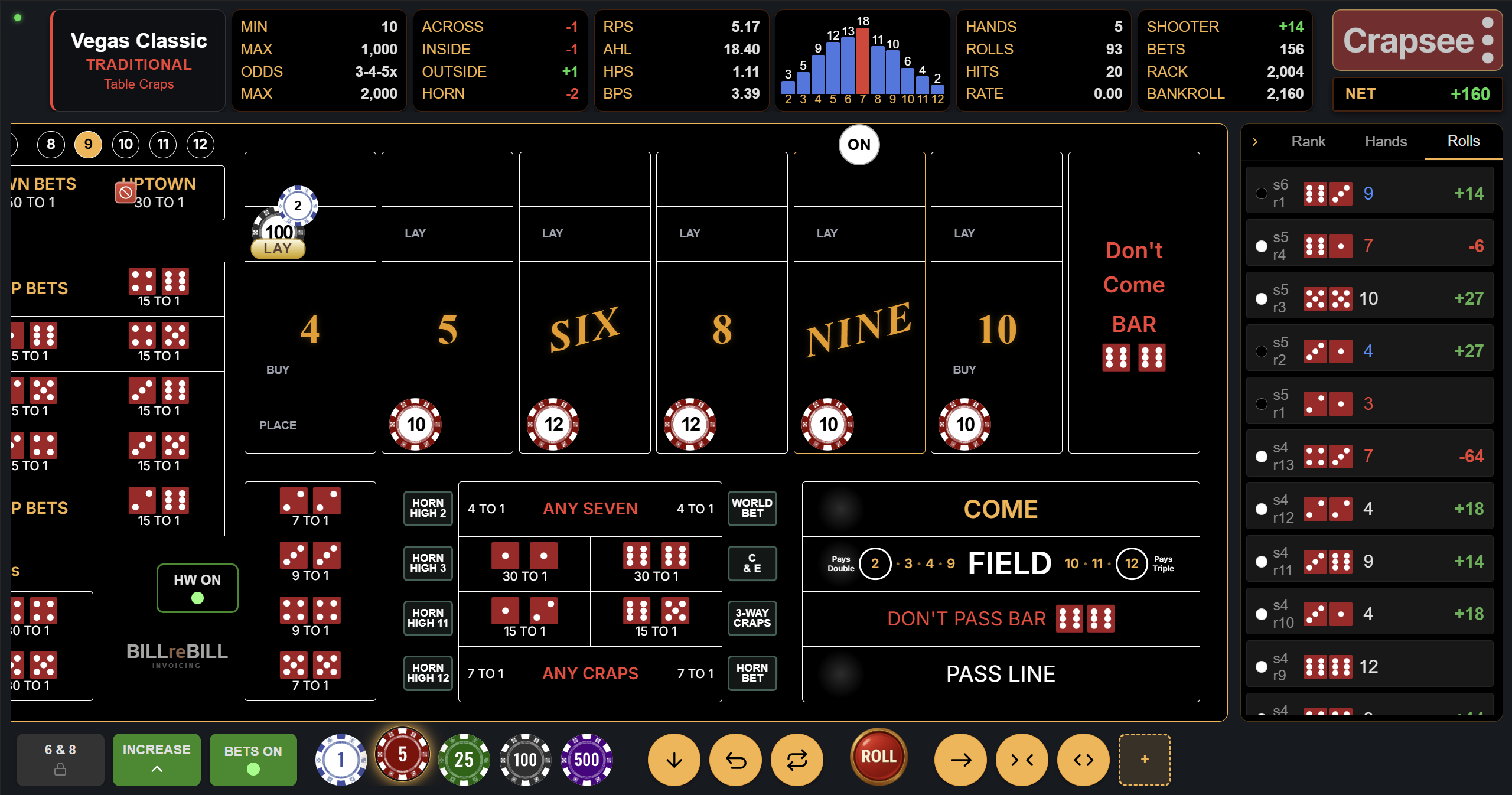
Every strategy ranking below is testable for free on Crapsee. Open the simulator in a second tab and run 50 rolls on each approach. The house edge numbers become real when you watch your bankroll move.
The 60-second version
Pass Line + Max Free Odds. Stop reading and play. Here is the ranking if you want more:
- #1 Pass Line + Max Odds — 0.33% edge at 5x. The math winner.
- #2 Don't Pass + Max Lay Odds — 0.27% edge at 5x. Marginally better math, harder psychology.
- #3 3 Point Molly — Under 0.5% combined edge. Best for action seekers.
- #4 Doey-Don't — Slow guaranteed drain. Kills time, not the house edge.
- #5 Iron Cross — ~3.87% edge. Feels safe. Bleeds bankroll. Avoid.
How we ranked these strategies
Three criteria, in this order of priority:
- House edge. The mathematical percentage the casino earns on every dollar wagered over time. Lower is better. This is the primary ranking criterion and it is not debatable — it is arithmetic.
- Simplicity. A strategy you execute correctly beats a theoretically superior strategy you fumble. We penalize complexity that produces mistakes.
- Bankroll efficiency. How much betting volume does the strategy require to get the same level of table coverage? Strategies that force you to put more money at risk to cover the same numbers rank lower.
One thing we did not rank on: how exciting the strategy feels. Iron Cross wins on almost every roll and feels electric. It also hemorrhages money faster than any other strategy on this list. Excitement and math are often inversely correlated at a craps table.
For the house edge numbers on every individual bet, see the craps odds and payouts chart.
Rank #1: Pass Line + Maximum Free Odds
Combined house edge: 0.60% at 2x — 0.33% at 5x — 0.18% at 10x
The Pass Line bet alone has a 1.41% house edge. That is already one of the lowest edges at any table game. The Free Odds bet behind it has a 0% house edge — the only true zero-edge bet offered in a standard craps game. When you combine them, the blended edge drops in proportion to how much of your total money is riding on the 0% odds bet.
The numbers: Pass Line carries a 1.41% house edge. Backing it with 5x Free Odds drops the combined edge to 0.33%. No other common bet in any standard table game beats it. At 10x odds the combined edge is 0.18%.
| Odds multiple | Combined house edge | Example: $10 Pass + odds bet |
|---|---|---|
| No odds | 1.41% | $10 Pass Line only |
| 1x | 0.85% | $10 Pass + $10 Odds |
| 2x | 0.60% | $10 Pass + $20 Odds |
| 3-4-5x | 0.37% | $10 Pass + $30-50 Odds (table-dependent) |
| 5x | 0.33% | $10 Pass + $50 Odds |
| 10x | 0.18% | $10 Pass + $100 Odds |
When to use it: Always, unless you have a specific reason to use #2.
The tradeoff: High odds multiples require more bankroll. If the table offers 5x odds but you can only afford $10 on the odds, you are playing at a higher effective edge than someone who takes the full 5x. Play the odds multiple your bankroll can sustain comfortably, not the maximum the table allows.
Simplicity: Very high. Place Pass Line bet, point gets set, place Free Odds behind it. Two bets. Done.
Rank #2: Don't Pass + Maximum Lay Odds
Combined house edge: 0.27% at 5x Lay Odds
The Don't Pass bet has a 1.36% house edge — marginally better than Pass Line's 1.41%, because the 12 on the come-out is a push rather than a loss for the casino. Adding maximum Lay Odds behind it produces a combined edge of approximately 0.27% at 5x. That is 0.06% better than Pass Line with 5x odds.
Why it is ranked #2 and not #1: The math is better, but the psychology is harder. On the come-out roll, 7 and 11 are the most common outcomes and they lose on Don't Pass. You win on 2 and 3, which together appear on 3 of 36 combinations. Most players find it psychologically uncomfortable to be rooting against the shooter on the come-out. The math advantage is real but small. If the psychological burden causes you to make mistakes, play #1 instead.
Lay Odds vs Free Odds: Lay Odds pay at true odds in reverse — you lay more to win less, because the Don't Pass side is favored to win once a point is set. You lay $12 to win $10 on the 6 or 8 (true 6:5 odds against). The 0% house edge applies to Lay Odds exactly as it does to Free Odds.
Best for: Players who want the absolute mathematical edge and are comfortable rooting against the pass.
Rank #3: 3 Point Molly
Combined house edge: under 0.5% at 3-4-5x odds (all three bets combined)
The 3 Point Molly is the best strategy for players who want more active coverage than a single Pass Line bet provides, without sacrificing the mathematical foundation of odds-based play. The mechanics:
- Place a Pass Line bet on the come-out. Add maximum Free Odds once a point is set.
- Place a Come bet. When it moves to a number, add maximum odds.
- Place a second Come bet. Add maximum odds when it moves.
- Now you have three numbers working simultaneously, all backed with 0% house edge odds. Stop adding Come bets here.
- When a bet resolves, replace it with a new Come bet to maintain three active numbers.
The math: Each individual bet is still Pass Line + Odds (0.33% at 5x) or Come + Odds (same math as Pass + Odds). Having three of them simultaneously does not increase the per-bet house edge. Your total money at risk is higher, but the edge percentage stays below 0.5%.
The tradeoff: When a 7 appears, all three bets lose simultaneously. The 3 Point Molly produces larger swings than a single Pass Line bet — bigger wins, but more dramatic losses. Bankroll requirements are higher. Plan for roughly three times the bankroll of a single Pass Line approach.
Best for: Players who want table coverage and action without abandoning the math. Intermediate players who understand odds bets and come bets mechanically.
Rank #4: Doey-Don't (the Hedge)
Net house edge: approximately 1.4% of one unit per come-out roll containing a 12
Doey-Don't means placing equal bets on Pass Line and Don't Pass simultaneously. The theory: hedge yourself against the come-out, so you do not win or lose on 7/11 or 2/3 — the bets cancel each other. Once a point is set, the Pass and Don't Pass are on opposite sides of the same bet and effectively cancel there too, so neither wins.
The problem: On the 12, Pass Line loses and Don't Pass pushes. You lose one unit with no offsetting win. The 12 appears on 1 of 36 come-out combinations (2.78% of come-outs). That is a slow but guaranteed drain every time a 12 rolls before a point is set.
Why players use it anyway: It keeps you at the table with minimal risk. If you have 15 minutes to kill and a modest bankroll, Doey-Don't will keep you playing longer than Iron Cross will. That is genuinely useful for some situations.
Why we ranked it #4: You are guaranteeing a small loss on the 12. By contrast, #1 and #2 expose you to variance but offer a genuinely low house edge. Doey-Don't does not reduce risk; it converts variance into a certain small loss. That is not the same thing.
Best for: Players at the table for social reasons who want low bankroll exposure. Not for players trying to minimize losses over a session.
Rank #5: Iron Cross
Combined house edge: approximately 3.87%
Iron Cross (Field bet + Place 5 + Place 6 + Place 8) covers 24 of the 36 possible dice combinations per roll. The only number that beats you is 7. Every other outcome wins something. On paper, winning on 24 out of 36 rolls sounds good.
The math that matters: The 6 ways to roll a 7 cost more than the 24 wins recoup. Here is why:
- A 7 kills all four bets simultaneously: Field, Place 5, Place 6, and Place 8 all lose at once.
- The individual wins on each non-7 roll are modest: Field pays even money (with 2x on 2 and 3x on 12 in standard craps), Place 5 and 9 pay 7:5, Place 6 and 8 pay 7:6.
- When the math is worked through, the combined house edge across all four bets is approximately 3.87%. That is nearly 12 times worse than Pass Line with 5x odds.
The feel vs the reality: Iron Cross feels safe because you win frequently. But frequent small wins punctuated by catastrophic 7-outs erode bankroll faster than a steady Pass Line + Odds approach. The winning streaks are longer but the losses are bigger.
Our recommendation: Do not use Iron Cross as a primary strategy. If you enjoy the feel of winning on almost every roll, use it as an occasional overlay during a hot streak — but understand you are paying a significant premium for the entertainment value.
Strategies to skip entirely
Martingale (double after every loss)
The Martingale doubles your bet after every loss, so a single win recovers all prior losses plus one unit of profit. The theory is seductive: you must eventually win, so you will always profit. The practice is catastrophic.
Every craps table has a maximum bet. A $10 player starting the Martingale hits the table maximum after 7 consecutive losses: $10, $20, $40, $80, $160, $320, $640. At that point the system requires $1,280 but the table says no. You have lost $1,270 and cannot continue the sequence. The Martingale does not fail rarely; it fails on any losing streak long enough to hit the ceiling, and those streaks happen regularly. It is not a strategy — it is a bankroll liquidator with delayed timing.
Proposition bet "systems"
Any Seven carries a 16.67% house edge. Horn bets average 12.5%. Hardways run 9-11%. Proposition bets are not part of any rational craps strategy. They are entertainment bets, and expensive entertainment at that. No combination of prop bets reduces to a lower house edge than Pass Line alone. Skip them entirely unless you genuinely enjoy the occasional thrill bet and are accounting for it as entertainment spending.
Hot table chasing
"This shooter is hot" is the craps equivalent of the gambler's fallacy. Each dice roll is independent. A shooter who has rolled 15 non-7 numbers in a row is not less likely to 7 out on the next roll. The dice have no memory. Increasing your bets because a table "feels hot" means increasing your exposure at the exact moment your intuition is least reliable.
Betting systems (Fibonacci, D'Alembert, Labouchere)
All progression systems share the same structural problem as the Martingale: they manipulate bet sizing but cannot change the house edge on each individual bet. The math of the game does not care about your bet sequence. Over time, your losses converge to (house edge) × (total money wagered), regardless of how you arranged the bets.
How to practice before playing
The most common strategy mistake is not choosing the wrong system — it is executing the right system incorrectly. Free Odds are left on the table because players forget to place them. Come bets move to numbers players did not expect. Payout math is misread. These execution errors cost real money.
The solution is repetition before the stakes are real. Run 100 rolls on Pass Line + 5x Odds on the free craps simulator. Watch the bankroll curve. Notice how rarely the house edge actually shows up in any single session — and how clearly it shows up across 1,000 rolls. That intuition is impossible to build at a real table and extremely cheap to build on a free simulator.
When you can place a Pass Line bet, remember to take odds after the point is set, and manage two Come bets without prompting, you are ready to play at a real table.
Frequently asked questions
What is the best craps strategy?
Pass Line with maximum Free Odds. The Pass Line carries a 1.41% house edge. Backing it with 5x Free Odds (0% house edge) drops the combined edge to 0.33%. For the absolute mathematical optimum, switch to Don't Pass with 5x Lay Odds for 0.27%. Both are dramatically better than any other craps betting system.
Does the 3 Point Molly work?
Yes, mathematically. The 3 Point Molly keeps three numbers active simultaneously — Pass Line + two Come bets, all with maximum odds. Combined house edge stays under 0.5% at 3-4-5x odds. It generates larger swings than a single Pass Line bet and requires more bankroll, but the per-bet edge is the same. Best for active players who want coverage on multiple numbers.
Is Iron Cross a good strategy?
No. Iron Cross covers 24 of 36 outcomes per roll but the combined house edge is approximately 3.87% — nearly 12 times worse than Pass Line with 5x odds. Winning on 24 out of 36 numbers feels good until a 7 hits and wipes all four bets at once. The math does not support it as a primary strategy.
What's the lowest house edge in craps?
Free Odds bets carry a 0% house edge, but you can only place them behind Pass Line, Don't Pass, Come, or Don't Come. The Pass Line itself is 1.41%. At 5x odds the combined edge is 0.33%. At 10x it drops to 0.18%. Don't Pass with 5x Lay Odds comes in at 0.27%.
Should I play Pass or Don't Pass?
Mathematically, Don't Pass is marginally better: 1.36% vs 1.41%, and Don't Pass + 5x Lay Odds beats Pass + 5x odds by 0.06% (0.27% vs 0.33%). In practice, most players choose Pass Line because winning on 7 and 11 feels natural on the come-out. The difference is tiny. Choose the one you will execute correctly and enjoy.
Is there a guaranteed way to win at craps?
No. Every craps bet has a positive house edge and no betting system, progression, or strategy eliminates it. The best you can do is minimize the edge with Pass Line and maximum Free Odds, manage your bankroll, set win/loss limits, and leave when you hit them.
What's the safest craps bet?
Free Odds at 0% house edge, but only available behind a line or come bet. Among standalone bets, Don't Pass at 1.36%. The worst are Any Seven (16.67%), Horn bets (12.5%), and Hardways (9-11%). Stay on Pass or Don't Pass with maximum odds and you are playing as safely as craps allows.
What is the Doey-Don't strategy?
Doey-Don't places equal bets on Pass Line and Don't Pass simultaneously. The bets largely cancel each other, creating minimal variance. The flaw: on the come-out 12, Pass Line loses and Don't Pass pushes, costing you one unit with no recovery. It is a slow guaranteed drain, not a risk reduction strategy. Useful for extending table time on a small bankroll, not for minimizing expected losses.
Does craps strategy really matter?
Yes. Not to change whether you win or lose long-term — the house always has an edge — but to control how fast you lose. Pass Line + 5x odds at 0.33% edge versus Any Seven at 16.67% means the Any Seven player loses roughly 50 times faster on the same bankroll. Strategy is what separates an hour of play from a week of play on the same budget.