
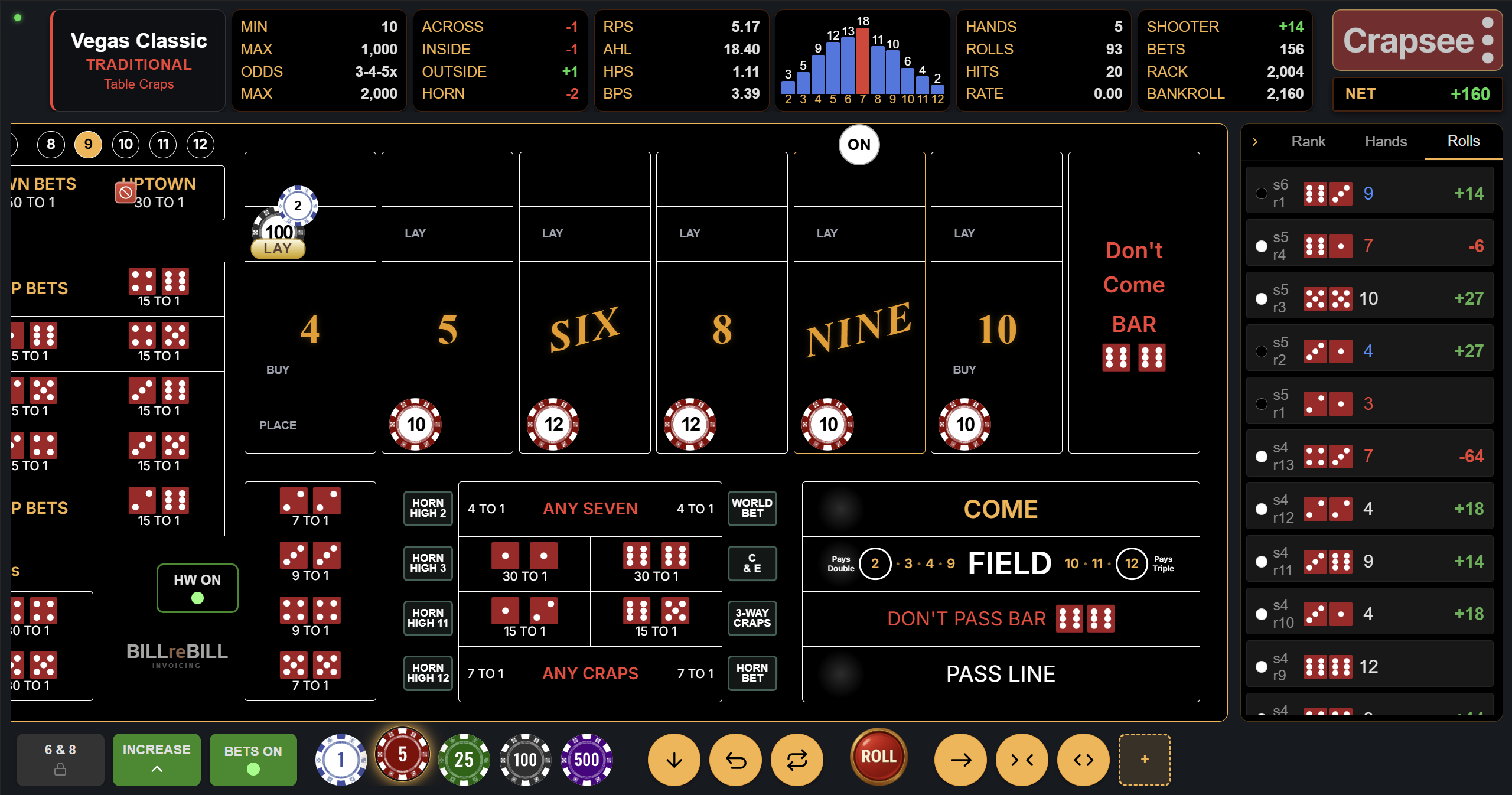
Craps is a dice game where you bet on the outcome of two dice. That sentence is the whole game. Everything you see on a craps table — the felt, the chips, the yelling dealers, the crowd — is just decoration around that one simple idea.
Try it before you read (seriously)
The fastest way to understand craps is to roll the dice. Not read about rolling the dice. Actually roll them.
Open the free Crapsee table in another tab right now. Click the Pass Line area, click Roll. Whatever happens — you just played craps. Come back here and the rest will make a lot more sense.
The 60-second version
- Put a chip on the Pass Line. This is your bet.
- Someone rolls two dice. This is called the come-out roll.
- If a 7 or 11 comes up: you win. If 2, 3, or 12 comes up: you lose. Either way, the round is over and you start again.
- Any other number (4, 5, 6, 8, 9, or 10) becomes "the point." Remember that number.
- Now the shooter keeps rolling. You need that point number to show up again before a 7.
- Point rolls again before a 7: you win. A 7 rolls first: you lose.
That is craps. The whole thing. You just learned craps.
What is craps, really?
Imagine you and a friend make a simple bet: "I'll pay you a dollar if you roll a 7 before you roll a 6. You pay me a dollar if you roll the 6 first." You hand one of you a pair of dice and start rolling. That is the core mechanic of craps.
The casino version just adds more people, more bets, a fancier table, and a lot more noise. But the underlying game is the same: two dice, specific numbers matter, keep rolling until someone wins or loses.
The table looks complicated because the casino wants you to see every possible bet at once. It is a menu. You do not have to order everything on the menu. You do not even have to read the whole menu. You need one item: the Pass Line. Order that, sit back, and you are playing craps.
Why does it look so chaotic?
A live craps table has around 20 different ways to bet. The felt is covered in boxes, numbers, and labels. Three or four casino employees are moving chips around and calling out results in what sounds like a private language. ("Yo eleven! Pay the line! Big red, no field!").
Here is the thing: none of that is mandatory for you.
Think of the craps table like a sports bar TV showing four games at once. Everyone else might be watching four games. You can watch one. You are not doing it wrong — you are just focused.
The chaos comes from players who have been playing for years making 10 bets simultaneously and tracking all of them at once. You will get there if you want to. For now: one bet. One number to watch. That is it.
Out of 36 possible dice combinations, only six produce a 7. That makes 7 the most common roll — which is why the whole game revolves around it. Before a point is set, 7 is your best friend. After a point is set, 7 is your worst enemy. Once you understand that one flip, the chaos starts to make sense.
The only bet you need: the Pass Line
The Pass Line bet is the standard craps bet. It is what most people at the table are playing. It wins about 49.3% of the time (just under even money), the casino keeps 1.41 cents on every dollar over time, and it is the lowest house edge of any "real" bet on the table.
Here is how it works in plain language:
- You put a chip on the area marked "PASS LINE" before the dice are rolled.
- If the first roll is a 7 or 11: instant win. Your chip doubles.
- If the first roll is a 2, 3, or 12: instant loss. Your chip disappears.
- Any other number (4, 5, 6, 8, 9, or 10): that number becomes "the point." Now you need the shooter to roll that number again before rolling a 7.
- Point rolls first: you win. 7 rolls first: you lose.
That is the Pass Line. You just learned the most important bet in craps. The rest of the table — the Field, the Hardways, the Proposition bets, the Come bets — is optional. Ignore them for now. They will be there when you want to explore.
For a deeper look at this specific bet, the Pass Line bet guide covers the odds in detail.
The come-out roll explained simply
Every round of craps starts with what is called the "come-out roll." Think of it like a coin flip with extra steps.
The come-out roll is the first roll of a new round. The shooter (whoever is throwing the dice right now) picks up two dice and throws them down the table. Three things can happen:
- Natural (7 or 11): Everyone on Pass Line wins immediately. Round over, start again.
- Craps (2, 3, or 12): Everyone on Pass Line loses immediately. Round over, start again.
- Point number (4, 5, 6, 8, 9, or 10): That number gets marked as "the point." The dealer puts a puck on it. Round continues to phase two.
The odds on the come-out strongly favor you: 8 out of 36 rolls are naturals (instant win), only 4 out of 36 are craps (instant loss), and the remaining 24 set a point. The come-out is the friendliest part of every round.
On a live table, you will hear "coming out!" called before the shot. That is your cue that a new round is starting. It is also your last chance to get a bet down before the roll.
The point round explained simply
Once a point is set, picture it this way: the shooter now has a "lucky number." They need to roll that lucky number one more time before the dice show a 7. Keep rolling until one of those two things happens.
Say the come-out roll was a 6. The point is 6. The dealer puts a white puck on the 6 on the table. Now:
- Shooter rolls a 3. Nothing happens. Keep rolling.
- Shooter rolls an 8. Nothing happens. Keep rolling.
- Shooter rolls a 6. Pass Line wins! Round over. New come-out starts.
- OR: Shooter rolls a 7. Pass Line loses. This is called "sevening out." Round over. Dice pass to the next player.
How likely is it that the point rolls before a 7? It depends on the point number. Out of every 36 rolls, a 6 appears 5 times and a 7 appears 6 times. So rolling a 6 again before a 7 happens about 45% of the time. A point of 4 or 10 is harder — only 3 ways to roll it vs 6 ways to roll a 7, so about a 33% chance of winning that point round.
The math is in the house's favor during the point round, which is why the come-out (where 7 and 11 are your friends) feels so much better. The game is designed to keep you engaged across both phases.
When you win
Winning on the Pass Line pays even money — your $10 bet wins you $10. Simple.
The dealer pushes chips to you and your original bet stays on the table. (You can take it down if you want, but most players leave it up for the next round.) The shooter keeps the dice and a new come-out roll starts.
Once you get comfortable, you can add "Free Odds" behind your Pass Line bet after a point is set. Free Odds is the only bet in a casino with zero house edge — it pays true math odds. A $10 Pass Line bet with $30 in Free Odds behind it drops your combined house edge to about 0.5%. That is not a typo. Half a percent. It is one of the best bets in any casino.
But one thing at a time. Get used to Pass Line first. Free Odds will be there when you are ready.
When you lose
Craps does not soften losses. When you seven out during the point round, the dealer sweeps your chip and the dice move to the next shooter. It happens fast.
The good news: Pass Line losses happen at a controlled pace. You lose on craps (2, 3, 12) during the come-out — about 11% of rolls. You lose when a 7 rolls during the point round. The house edge over time is 1.41 cents per dollar. That is very manageable compared to other table games.
What trips beginners up is not the math — it is the noise. A 7-out at a live table feels dramatic because the whole crowd reacts. Chips disappear, the stickman calls it loudly, energy drops. Take a breath. The next come-out is 15 seconds away. This is normal and expected in craps. Every shooter eventually sevens out.
The fastest way to get past the sting of a loss is to practice first on a free simulator where no real money is involved. Once you have seen 50 seven-outs on the free craps simulator, they stop feeling catastrophic and start feeling routine.
How to practice without losing money
This is the most important section on this page. Ready?
Do not sit at a real craps table until you have rolled the dice 100 times for free first.
Craps moves fast. At a real table, there is social pressure, chips flying around, dealers calling numbers, other players chatting. If you are simultaneously trying to figure out the rules, count your chips, watch the puck, and decide what to bet — it is overwhelming. Mistakes happen. Bad bets get made. Money disappears.
The solution is boring and obvious: practice for free first. Crapsee's free craps table is available with no signup and no real money. Roll a hundred times. Watch the puck move. See what a point round looks like from start to finish. Get the rhythm. Then walk into a real casino with confidence.
Even experienced players use simulators to test specific bet combinations or just warm up before a trip. There is no downside to free practice and a very real upside: you arrive at the table knowing what you are doing.
Where to go next
You now understand craps well enough to sit down and play. Genuinely. Go try the free table, roll some dice, and see how it feels before reading anything else.
When you want more depth, here is the natural progression:
- Understand the Pass Line better: The Pass Line bet guide covers odds, Free Odds, and when to take them.
- See all the rules spelled out: The craps rules page covers every situation you will encounter at a real table.
- Structured tutorial approach: If you want the "Step 1, Step 2" format with more detail on every phase of the game, the step-by-step beginner's guide covers all of it.
- Jargon you hear at the table: The craps glossary explains "yo", "big red", "hard eight", and everything else the stickman says that sounds like another language.
But honestly — go play first. Reading about craps is the second-best way to learn it.
Frequently asked questions
Is craps hard to learn?
No. It looks hard because the table shows 20+ bets all at once. But you only need one bet to start: the Pass Line. Everything else is optional. Most beginners play nothing but Pass Line for their first dozen sessions and have a great time.
Do I have to throw the dice myself?
No. When it is your turn, you can simply say "I pass" and let the next person shoot. Nobody will mind. The dice pass around the table, but throwing is never required. Plenty of players just bet and never shoot.
Can I just watch first?
Absolutely. Stand behind the table, watch a few rounds, and get a feel for the pace before putting any chips down. Craps is one of the few casino games where watching is perfectly normal and even expected for newcomers.
What is the cheapest bet at a craps table?
The Pass Line minimum is whatever the table minimum is — often $5 or $10 at a real casino. Online simulators like Crapsee have no minimum at all. The Pass Line is also one of the best bets on the table by house edge, so cheapest and smartest point in the same direction for once.
Why is craps so loud?
Because wins and losses happen fast and everyone at the table is usually rooting for the same outcome. When the shooter makes their point, it feels like a group win — and people cheer. When a 7 shows up after a point is set, everyone groans together. The communal energy is kind of the whole point.
Do I need to know all the bets before I play?
No. You need exactly one bet: the Pass Line. That is it. You can walk up to a craps table, place a Pass Line bet, and play a full session without learning anything else. Add more bets as you get comfortable, not before.
Is craps a good game for beginners?
Yes, with one caveat. If you stick to Pass Line with odds, craps has one of the lowest house edges in the building — around 1.41% on Pass Line, dropping lower when you add Free Odds behind it. The problem is beginners sometimes get drawn into prop bets with 10–16% edges. Stick to Pass Line and craps treats you well.
How long does a round of craps take?
Anywhere from 5 seconds to 10 minutes. The come-out roll can end a round instantly (if a 7, 11, 2, 3, or 12 shows up). If a point gets set, the round continues until either the point is rolled again (win) or a 7 appears (loss). Average rounds at a live table take 2–4 minutes total.