
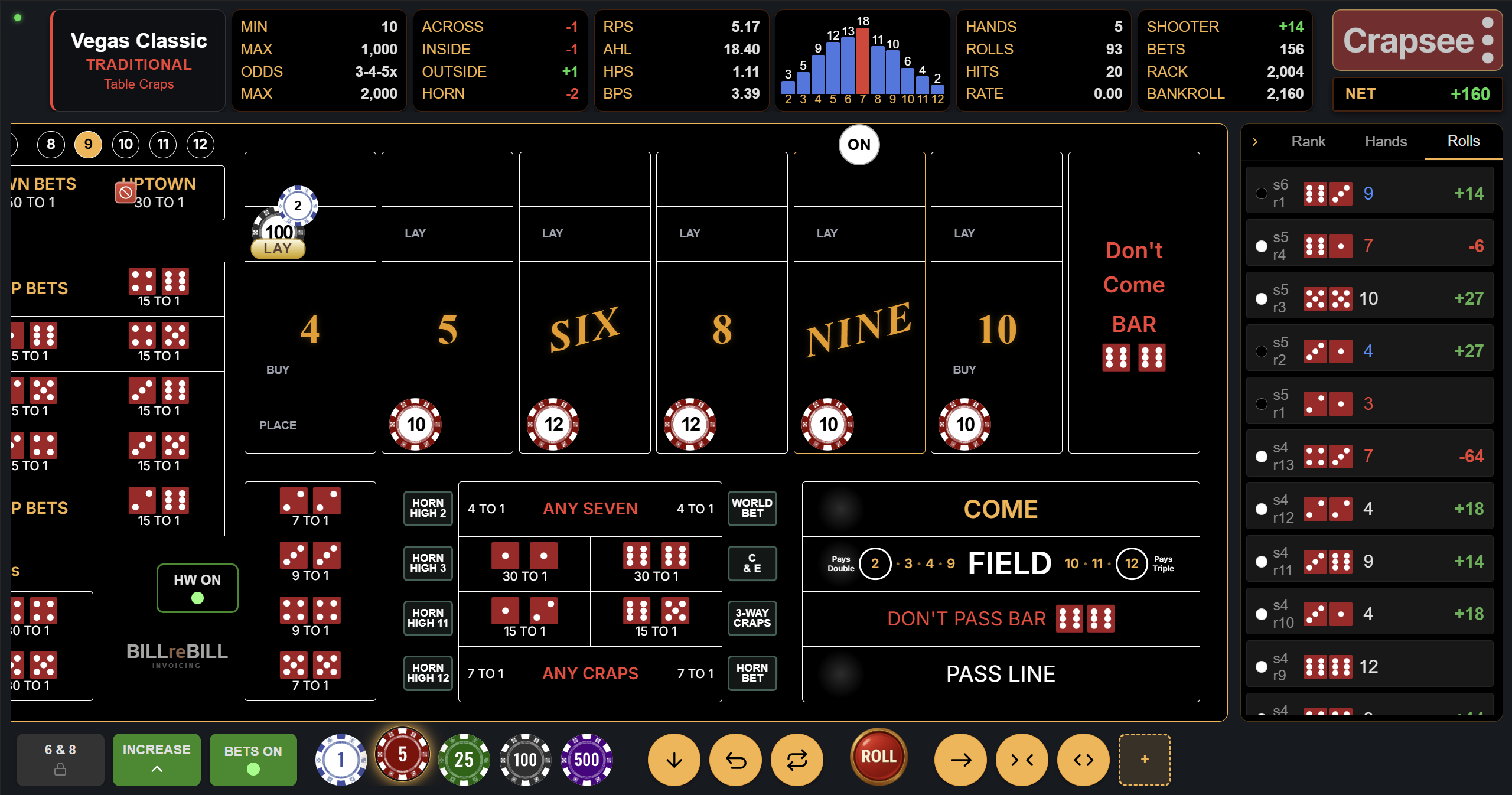
Craps rules are simpler than the table makes them look. The core game has two phases (come-out roll and point round), a small number of mandatory bet types, and clear rules for when you can and cannot act. This page is the full rule book - if you know what is on this page, you know how to play craps correctly at any casino in the world.
Basic craps rules for beginners
Here is the shortest honest rule summary in craps. If you absorb these 6 rules, you can play a round at any casino in the world:
- Place a Pass Line bet before the come-out roll.
- A 7 or 11 on the come-out wins the Pass Line at 1 to 1.
- A 2, 3, or 12 on the come-out loses the Pass Line (this is "craps").
- Any other number (4, 5, 6, 8, 9, 10) sets the point. The shooter keeps rolling.
- During the point round, rolling the point again wins the Pass Line.
- Rolling a 7 during the point round loses the Pass Line. This is "seven out" - the round ends and the next player shoots.
That is literally it. Everything else on the craps table - place bets, come bets, hardways, the field, propositions - is optional variations on these core rules. You can play a full session of craps competently using only the 6 rules above. The rest of this page covers the details and edge cases.
Come-out and point round (reference)
This page is the rule book. For step-by-step beginner coverage of the come-out roll, the point round, and how a round resolves, see how to play craps. The 6-rule summary above is the minimum you need; the rest of this page covers the formal rules every craps player should know to act correctly at any live or electronic table: shooter conduct, bet timing, dice protocol, the bar-12 rule, house variations, and the resolution order when multiple bets are on the felt.
Shooter rules
The shooter is the player currently rolling the dice. Every player at the table gets a turn to shoot, with the dice rotating clockwise after each seven-out.
- You must place a line bet to shoot. Before the come-out roll, the shooter is required to place a pass line bet OR a don't pass bet. You cannot shoot without one. Most shooters choose pass line.
- You can decline the dice. When it is your turn to shoot, you can pass. The stickman offers the dice to the next player.
- Use one hand. The shooter must pick up and throw the dice with one hand only. Switching hands mid-roll is not allowed.
- Keep the dice over the table. The shooter cannot lower the dice below the table edge or pass them to another hand. Doing so voids the roll and the dice are returned to the stickman for inspection.
- The dice must hit the back wall. A throw that does not reach the far end of the table is usually called a "short roll" and may be re-thrown. This rule prevents the shooter from placing the dice in a specific position rather than rolling them.
Bet timing rules
Craps has strict rules about when bets can be placed, removed, or modified. Getting this wrong is the fastest way to embarrass yourself at a live table.
- Pass line and don't pass: Can only be placed before a come-out roll. Once a point has been set, the line is "closed" and new pass/don't pass bets cannot be added.
- Come and don't come: Can only be placed AFTER a point has been set. They act like a personal come-out roll for each come bet.
- Place bets: Can be placed, increased, decreased, or removed at any time between rolls, as long as the dice are not in motion.
- Odds bet: Can be added to an existing pass line, don't pass, come, or don't come bet at any time before the bet is resolved. The odds bet can also be taken down at any time.
- Field and proposition bets: Single-roll bets. Must be placed before the shooter rolls. Resolved immediately on the next roll.
The universal rule: once the dice are in motion, the table is closed. You cannot place, remove, or modify any bet until the dealer has finished paying out and called the table open again.
Dice protocol
The dice themselves are subject to their own rules that exist to prevent cheating:
- Hit the back wall: Every roll must reach the far wall of the table. Most casinos allow one "short roll" warning before enforcing a re-throw.
- Both dice must land flat: If one die lands on top of chips, on the rail, or on an uneven surface ("cocked die"), the stickman calls the roll based on what the die "would have shown" or declares it a no-roll.
- Dice off the table: If one or both dice fly off the table, they are retrieved and inspected for damage. They may be returned or replaced. Some superstitious players believe dice leaving the table causes the next roll to be a 7 - this is just superstition, but you will hear it at every table.
- One-hand throw: The shooter must pick up both dice with one hand and throw them with the same hand.
- No touching the dice mid-roll: Once the stickman has released the dice to the shooter, no one else can touch them until after the roll has been called.
The "bar 12" rule
On most craps tables, the come-out roll of 12 is a "push" (tie) for don't pass bettors instead of a win. Your don't pass bet is returned to you with no win or loss. This rule gives the house a small edge on don't pass - without it, don't pass would have a negative expected value for the casino.
Some casinos (especially in Nevada) "bar the 2" instead of the 12. The math is identical - the house gives up the win on one combination out of two that would otherwise favor don't pass. Check the posted table rules to know which number is barred.
House rule variations
The rules above are universal. A few rules vary by casino, and you should check each table before playing:
- Maximum odds offered: Most tables offer 2x, 3-4-5x, or 10x odds on pass line bets. Higher is better for the player. "3-4-5x" means you can take 3x odds on a 4 or 10 point, 4x on a 5 or 9, and 5x on a 6 or 8.
- Don't come bar number: Same as don't pass - barred on 12 or 2 depending on table.
- Field bet double/triple numbers: Most tables pay double (2 to 1) on a 2 or 12. Some pay triple (3 to 1) on ONE of them (usually the 12). Check the posted field payouts.
- Big 6 and Big 8: Some tables have "Big 6" and "Big 8" boxes in the corners that pay 1 to 1. These are the same bet as place 6 and place 8 but with worse payouts - always place the 6 or 8 instead.
- Vig on buy bets: Buy bets pay true odds but charge a 5% commission ("vig"). Some casinos collect the vig only on winning buy bets; others collect it when the bet is placed. The first is better for the player.
Electronic table formats such as bubble craps follow the same core rules but automate the dice roll with a random number generator inside a dome - the bet timing rules and resolution order are identical.
Resolution order
When multiple bets are on the table at the same time, they are resolved in a specific order after each roll:
- Single-roll proposition bets (any seven, any craps, horn, hardways resolved this roll, field).
- Line bets affected by this roll (pass line wins on the point, loses on 7; come bets, etc.).
- Place bets affected by this roll (a place 6 bet wins when 6 is rolled, loses on a 7).
- The dealer settles all winners and losers before calling the table open for new bets.
This matters because fast rolls can produce multiple bet resolutions in one roll. A 7 during a point round resolves every on-the-table bet that cares about sevens at once: pass line loses, don't pass wins, every place bet loses, every hardway loses, every come bet on a number loses, and any "any seven" proposition wins.
Frequently asked questions
What are the basic rules of craps?
Craps has two phases: the come-out roll and the point round. On the come-out, a 7 or 11 wins the pass line, 2/3/12 loses, and 4/5/6/8/9/10 sets the point. In the point round, the shooter must roll the point again before rolling a 7.
What happens if the shooter rolls a 7 in craps?
On the come-out roll, a 7 is a "natural" and pass line bets win. During the point round, a 7 is a "seven out" - pass line bets lose and the shooter loses the dice.
Does the shooter have to bet on themselves?
Yes. The shooter is required to place a pass line or don't pass bet before the come-out roll.
Can the dice roll off the table?
Yes, and it is allowed but discouraged. Most casinos require the dice to hit the back wall of the table on every roll.
What is the "bar 12" rule in craps?
On the come-out roll, a 12 is a push (tie) for don't pass bettors. Your bet is returned with no win or loss. This rule gives the house an edge on don't pass.
Can you bet while the dice are in motion?
No. Once the shooter has the dice, the table is closed until the dealer has paid out the previous roll.
Do craps rules vary between casinos?
The core rules are universal. Variations include maximum odds offered, the bar number (12 or 2), field payout structures, and buy bet commission timing. Always check posted table rules.