
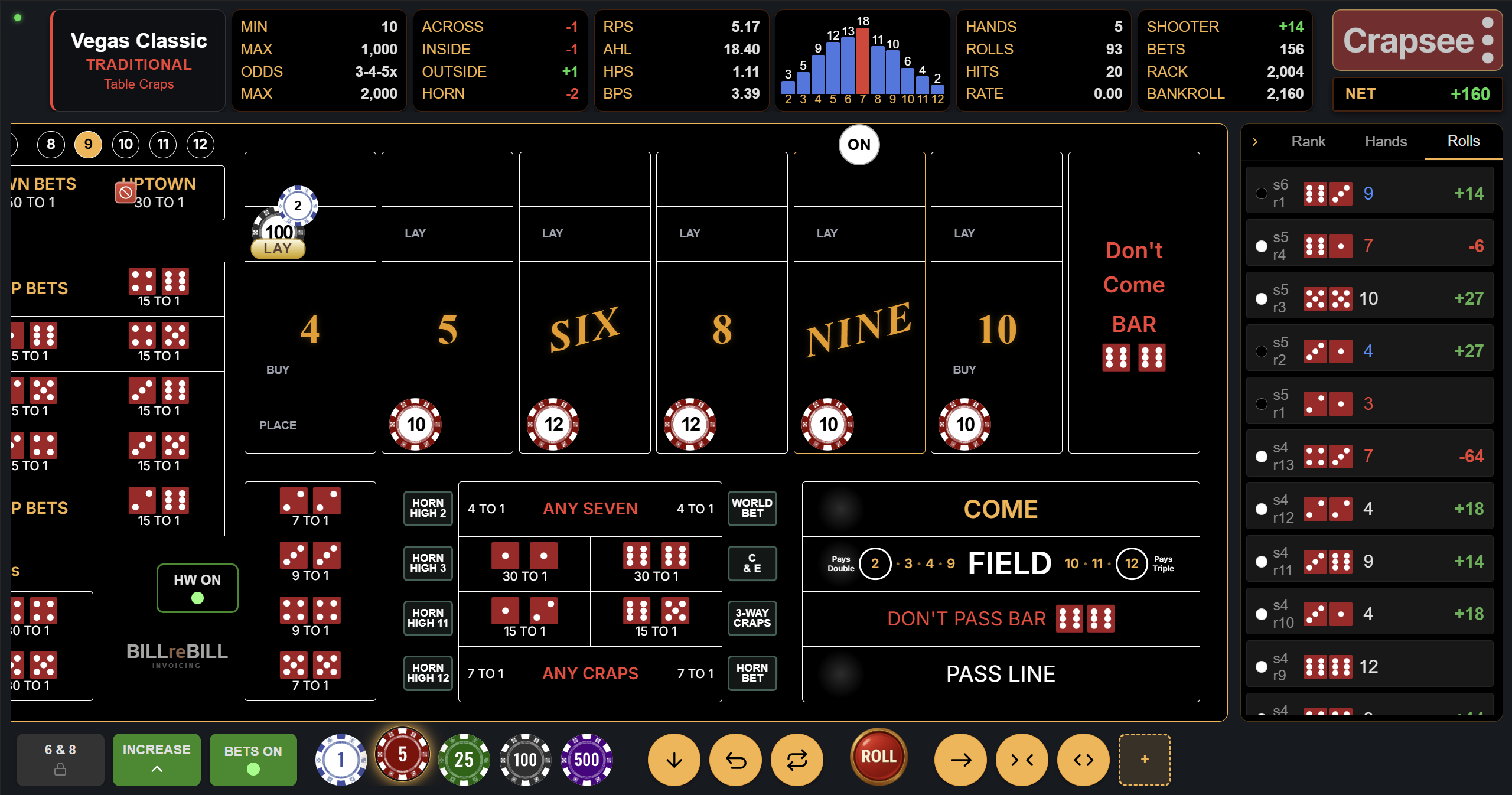
A Place bet is a wager on a specific number — 4, 5, 6, 8, 9, or 10 — to appear before a 7, placed at any time during a craps round by telling the dealer which number you want. Learn how they work, what they pay, and when they belong in your session alongside the Pass Line bet and all all craps bets explained.
Practice Place Bets Free
The fastest way to understand Place bets is to see them in action. Crapsee's free craps simulator lets you place the 6, press after a hit, and watch a 7-out settle everything — no signup, no real money, no pressure. Open the table and follow along as you read.
The 60-second version
- Wait for a point to be established — Place bets are a point-round bet. Make them after the come-out.
- Tell the dealer which number you want. "Place the 6" or "Place the 6 and 8 for $12 each."
- The dealer sets your chips in the Place bet box on the number on the layout.
- If your number rolls before a 7, you win and your bet stays up. If a 7 rolls, you lose.
- After a win, choose: press (double up), regress (reduce), take it down (remove), or same bet (stay).
- You can remove or reduce Place bets at any time — unlike Pass Line bets, they are never locked in.
What is a Place bet in craps?
A Place bet is a direct wager on one of six numbers — 4, 5, 6, 8, 9, or 10 — to be rolled before a 7 appears. You do not need to wait for the come-out roll or go through the Come bet travel process. You simply tell the dealer the number you want, hand over your chips, and the bet is live immediately.
Place bets sit in labeled boxes at the top of the craps layout, one box per number. The dealer positions your chips in the section of the box that corresponds to your spot at the table. This is how the crew tracks which chips belong to which player — never toss chips onto a Place bet box directly. Slide them toward the dealer and name the bet.
Place bets are "contract" bets in one direction only: you can take them down or reduce them whenever you want, but the house cannot remove them from you once a point is established. This flexibility is one of the biggest practical advantages over Come bets, which lock in after the come-out and cannot be taken down once they travel to a number.
The six Place numbers explained
Each of the six Place numbers has its own probability profile, payout ratio, and house edge. They split cleanly into three pairs based on how many ways each number can roll on two dice.
Place 6 and Place 8 — the value numbers
The 6 and 8 each have five ways to roll out of 36 possible dice combinations. A 7 has six ways. So before a 7 appears, the 6 (or 8) wins 5 out of 11 rolls on average — the highest win rate of any Place number. At a live table paying 7-to-6, the house edge is 1.52%. This makes Place 6 and Place 8 the most favorable Place bets available, and competitive with many other non-odds bets on the craps layout. Bets must be in $6 increments to receive the correct payout (a $5 Place 6 pays only even money, not 7-to-6).
Place 5 and Place 9 — the middle numbers
The 5 and 9 each have four ways to roll versus six for the 7. Win rate is 4 out of 10 rolls before a 7 — slightly lower than the 6 and 8. Live tables pay 7-to-5 on Place 5 and 9, which produces a house edge of 4.00%. That is meaningfully worse than the 6/8 but not disqualifying for players who want coverage on those numbers. Bets work best in $5 increments.
Place 4 and Place 10 — the long shots
The 4 and 10 each have only three ways to roll versus six for the 7. Win rate drops to 3 out of 9 rolls, or one-in-three. Live tables pay 9-to-5, which yields a 6.67% house edge. That is a significant edge — roughly four times worse than Place 6/8. The 4 and 10 are worth placing only when you specifically want action on those numbers, and the Come bet with odds is a better vehicle for getting to those numbers if the math matters to you.
A note on Buy bets: the 4 and 10 can also be covered with a Buy bet, where you pay a 5% commission up front in exchange for true odds payouts (2-to-1). At 5% vig the Buy 4/10 house edge drops to approximately 4.76% — still worse than Place 6/8 but better than the Place 4/10 at 6.67%. If you want the 4 or 10 and you are betting at least $20, the Buy bet is worth the commission.
Place bet payouts and house edges
The full payout table for live craps. See the craps odds and payouts chart for a complete house edge table covering every bet on the layout.
| Number | Ways to roll | Ways a 7 rolls | Live payout | House edge | Min unit size |
|---|---|---|---|---|---|
| Place 6 | 5 | 6 | 7 to 6 | 1.52% | $6 |
| Place 8 | 5 | 6 | 7 to 6 | 1.52% | $6 |
| Place 5 | 4 | 6 | 7 to 5 | 4.00% | $5 |
| Place 9 | 4 | 6 | 7 to 5 | 4.00% | $5 |
| Place 4 | 3 | 6 | 9 to 5 | 6.67% | $5 |
| Place 10 | 3 | 6 | 9 to 5 | 6.67% | $5 |
The math behind each payout: Place 6 wins 5 times and loses 6 times out of 11 relevant outcomes. True odds would be 6-to-5 (paying $6 on a $5 bet). The house pays 7-to-6 instead — slightly worse than true odds — and keeps the difference as its edge. Every Place bet payout is calculated this way: slightly below true odds, with the shortfall representing the house edge.
Working, off, and the come-out rule
Place bets have a default state that many new players do not know about: they are OFF on the come-out roll.
The come-out roll is the first roll of a new round, when the shooter is trying to establish a point. A 7 on the come-out is a winner for Pass Line bettors — but a 7 would also kill any active Place bet. To prevent this conflict, casinos automatically turn Place bets off during the come-out. A white "OFF" button may appear on your chips, or the dealer will tell you they are off. If a 7 rolls during the come-out, your Place bets are unaffected.
Turning Place bets "working" on the come-out
You can override this default by telling the dealer "Place bets working" before the come-out. Your bets will then be live for that roll. This is a personal preference choice. Some players want to cover the 6 and 8 on every single roll including the come-out; others prefer the protection the default off-state provides. There is no mathematically correct answer — the house edge is the same either way, since the come-out 7 is equally likely regardless of your preference.
Once a point is established
After the come-out establishes a point, all Place bets automatically switch to ON. They stay ON for every roll of the point round until one of these happens: the shooter rolls a 7 (you lose), your number rolls (you win and the bet stays up unless you call it down), or you tell the dealer to take the bet down or turn it off.
Press, regress, down, and same bet commands
After a Place bet wins, the dealer will return your winnings and leave your original bet in place. At that moment you have four options. Knowing these commands is the difference between looking like a regular and looking lost at the table.
Press it
"Press it" doubles your bet using the winnings. If you had $6 on the Place 8 and it hit for $7, pressing adds $6 from the $7 win back onto the bet (now $12 on Place 8) and the dealer returns $1 change. Pressing is the most common table command after a win. You can also say "press by $6" or "press by $12" to specify an exact increase rather than a full double.
Regress it
"Regress it" reduces the bet. After a Place 6 hit with $12 on the number, you might say "regress the 6 to six dollars" and pocket the difference plus the win. Regression is a deliberate bankroll-management move: you came in heavy to maximize the first-hit payout, then reduced exposure for all subsequent rolls. The classic 6/8 regression strategy (covered below) uses this command explicitly.
Take it down
"Take it down" removes the bet entirely. The dealer returns all chips to you. This is how Place bets differ from Pass Line and Come bets — those cannot be taken down once the point is set, but Place bets always can. Use "take it down" when you sense a 7-out is coming, when you want to color up and leave, or when the shooter is leaving and the new shooter is an unknown.
Same bet
Saying nothing, or "same bet," leaves your bet at the same amount and returns the full winnings to you. This is the default if you do not give any instruction. The bet stays up at the same level for the next roll.
Place bet vs Come bet: which is better?
This is the most common strategic question for players who have learned the Pass Line and want to cover more numbers. The honest answer is: both have a role, and the right choice depends on how you play.
Come bet advantages
A Come bet works exactly like a Pass Line bet from a fresh come-out. It starts in the Come box, travels to a number after the next roll, and then qualifies for Free Odds — the bet with zero house edge. A Come bet on the 6 with $6 odds behind it costs the house edge only on the flat $5 portion, not on the odds. Combined house edge for a $5 Come with $6 odds: well below 1%. That is mathematically better than a Place 6 at 1.52%.
Place bet advantages
Place bets give you immediate, exact control. You choose the number now, not whatever happens to roll next. You can remove them whenever you want. They do not require a come-out process or an intermediate roll. For players who specifically want the 6 and 8 and nothing else, Place bets are faster and cleaner. The 1.52% house edge on Place 6/8 is low enough that the convenience premium is real.
When to use each
If you play with full odds on every Come bet and you are disciplined about keeping them working, Come bets win mathematically over long sessions. If you want targeted coverage on specific numbers, quick setup, or the ability to take bets down between shooters, Place bets — especially 6 and 8 — are the better practical tool. Many experienced players use both: a Pass Line with odds as the primary bet and Place 6/8 for additional coverage without waiting for the Come bet process.
Live table vs bubble machine Place bet payouts
Place bet math changes meaningfully depending on whether you are at a live craps table or an electronic bubble craps machine. The difference matters most on the 6 and 8.
| Number | Live table payout | Live house edge | Bubble machine payout | Bubble house edge |
|---|---|---|---|---|
| Place 6 / 8 | 7 to 6 | 1.52% | 6 for 5 (typical) | ~2.78% |
| Place 5 / 9 | 7 to 5 | 4.00% | 7 to 5 (usually same) | 4.00% |
| Place 4 / 10 | 9 to 5 | 6.67% | 9 to 5 (usually same) | 6.67% |
The critical distinction on bubble machines is "6 for 5" versus "7 to 6." These sound similar but mean different things. "7 to 6" means you win $7 and keep your $6 bet — net gain $7. "6 for 5" means the total returned to you is $6 including your $5 original bet — net gain $1 on a $5 bet, which is equivalent to 1-to-5. That nearly doubles the house edge compared to a live table. If you play bubble craps and the machine pays 6-for-5 on Place 6/8, you are better off putting that money into Free Odds behind your Pass Line instead.
Classic 6 and 8 regression strategy
The regression strategy is one of the most widely used Place bet approaches at a live table. It balances the desire for a large first-hit payout against the risk of losing a full position on an early 7-out.
How it works
Start with $12 on Place 6 and $12 on Place 8 — $24 total at risk. After the first hit on either number, you receive $14. Call "regress both to six" and the dealer reduces each bet to $6, returning the remaining chips to you. Your new exposure is $12 total. The math at that point:
- You started with $24 at risk and collected $14 on the first hit
- After regression, you have $12 at risk with $2 net profit already locked in
- If a 7 hits now, your net loss is $10 ($12 lost minus $2 locked profit), compared to $24 lost if you had not hit anything
- Every subsequent hit on the 6 or 8 pays $7 and grows your profit from there
What it is solving for
The regression strategy accepts a slightly lower expected value in exchange for a meaningful reduction in variance. It does not change the house edge — the 1.52% on Place 6/8 is the same regardless of bet sizing. But it reduces the frequency and magnitude of painful sessions where a 7-out comes before a single hit. Players who tilt after early losses benefit more from regression than players who can sustain variance without changing their behavior.
For more on how Place bets fit into broader session plans, see the craps strategy guide covering the major approaches used at live and electronic tables.
Common Place bet mistakes
Betting the wrong unit size
Place 6 and Place 8 must be bet in $6 increments to receive the 7-to-6 payout. A $5 Place 6 pays even money — not 7-to-6 — because the dealer cannot return fractional chips easily. The same applies to Place 5/9 at $5 increments and Place 4/10 at $5 increments. If you are unsure, ask the dealer what minimum gets you the correct payout. They tell you every time without judgment.
Leaving Place 4/10 when you should Buy
At bet sizes above $20, the Buy bet on 4 and 10 (paying 2-to-1 with 5% vig) beats the Place 4/10 (paying 9-to-5). The 5% commission on a $20 Buy is $1 — and the true-odds payout gives you $40 on a win versus $36 on a Place 9-to-5 bet. Net: paying $1 more for $4 more in winnings. Above $20, always Buy the 4 and 10 instead of placing them.
Leaving bets up through a shooter change
When the dice pass to a new shooter, taking Place bets down is a common conservative move. You lose no chips, face no house edge on that come-out, and re-evaluate once the new shooter establishes a point. This is table etiquette awareness: experienced players rarely leave full Place positions exposed through a come-out on an unknown shooter.
Treating Place 6/8 advice as universal for bubble craps
The standard advice to "start with Place 6 and 8" is accurate for live tables. On bubble machines paying 6-for-5, that advice is wrong. On a bubble machine, Free Odds behind your Pass Line is better than Place 6/8 at the reduced payout rate. Check the paytable on the machine before placing any number bets.
Spreading to all six numbers
Covering all six Place numbers at once ("across the board") feels like maximum coverage but spreads bankroll thin and adds up to a high combined house edge exposure per roll. Focusing on Place 6 and 8 keeps house edge at 1.52% on both bets and concentrates your money on the numbers with the best odds. The 4, 5, 9, and 10 are better accessed via Come bets with odds if you want them.
Frequently asked questions
What is a Place bet in craps?
A Place bet is a wager on a specific number — 4, 5, 6, 8, 9, or 10 — to be rolled before a 7. Unlike a Pass Line or Come bet, you tell the dealer to "place" the number and the bet is active immediately with no come-out roll required. Place bets can be made or removed at any time during a round.
How much does Place 6 pay?
At a live craps table, Place 6 pays 7-to-6. On a $6 bet you win $7 (net). The house edge is 1.52%, making Place 6 and Place 8 the most favorable Place bets on the layout. On bubble machines the payout is often reduced to 6-for-5, which nearly doubles the house edge to around 2.78%.
What are Place bet odds for all six numbers?
Place 6 and Place 8 pay 7-to-6 (house edge 1.52%). Place 5 and Place 9 pay 7-to-5 (house edge 4.00%). Place 4 and Place 10 pay 9-to-5 (house edge 6.67%). Bets must be in the correct unit size to receive the correct payout: $6 units for 6/8, $5 units for 5/9 and 4/10.
Are Place bets always working?
No. By default, Place bets are OFF on the come-out roll. A 7 on the come-out does not collect your Place bet while it is off. Tell the dealer "Place bets working" before a come-out if you want them active. Once a point is set, Place bets automatically turn ON for all subsequent rolls in that round.
Place bet vs Come bet — which is better?
Come bets earn Free Odds after traveling to a number, which drops the combined house edge below 1% with full odds. Place bets are faster, easier to take down, and give you exact number control. Place 6 and 8 at 1.52% are close enough to Come bets in practice that the convenience difference is real. If you play with full odds on every Come bet, Come bets win mathematically over long sessions.
What happens to my Place bet on the come-out roll?
Place bets are turned OFF by default on the come-out. A 7 on the come-out does not collect them while they are off. If you want your Place bets active on the come-out, tell the dealer "Place bets working" before the roll. After a point is established, Place bets automatically switch to ON.
Can you press a Place bet?
Yes. After a win, tell the dealer "press it" to double your bet using your winnings. You can also say "press by [amount]" for a specific increase, "regress it" to reduce the bet, "take it down" to remove it entirely, or say nothing to collect winnings and leave the same bet up.
What is the Place 6 and 8 regression strategy?
Start both Place 6 and Place 8 at $12 each ($24 total). After the first hit, collect the $14 win and regress both bets to $6 each. Your exposure drops from $24 to $12, with $2 net profit already locked in. Every subsequent hit on either number grows your profit. The strategy trades lower expected value for reduced variance on early 7-outs.