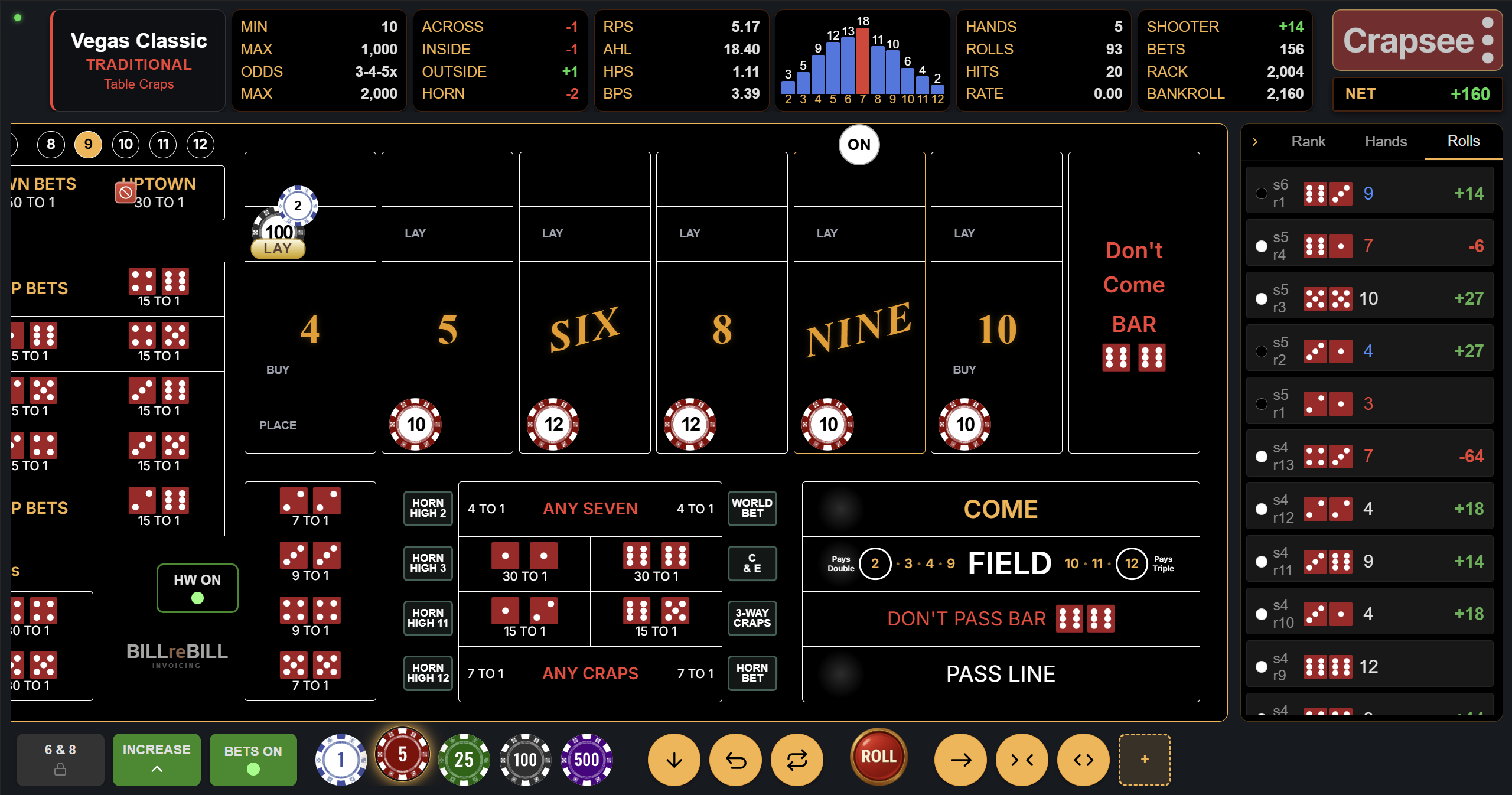
Field bets, Hardways, Horn, Yo, Any 7, Any Craps, C&E, and Hop bets are the proposition and high-edge section of the craps table. Some carry house edges above 16%. One of them (the Field, at the right table) is almost reasonable. This guide covers what every prop bet pays, what the house actually takes, and when - if ever - playing them makes sense. For a complete overview of all craps bets explained, start there first.
Practice prop bets free on Crapsee
Before putting real money on any proposition bet, practice it free. Crapsee's simulator has the full proposition box - Field, Hardways, Horn, Yo, Any 7, Any Craps, C&E, and Hop bets - with accurate payouts and house edges. You can feel how often the 7 wipes out a Hardway or how rarely the Field 12 appears.
The 60-second version
- Field bet - one-roll on 2/3/4/9/10/11/12. House edge 2.78% (3:1 on 12) or 5.56% (2:1 on 12). Acceptable at 3:1 tables.
- Hard 6 and Hard 8 - win on 3-3 or 4-4. Pay 9:1. House edge 9.09%. High but not catastrophic.
- Hard 4 and Hard 10 - win on 2-2 or 5-5. Pay 7:1. House edge 11.11%. Worse.
- Yo (11) - one-roll. Pays 15:1. House edge 11.11%.
- Any Craps - one-roll on 2, 3, or 12. Pays 7:1. House edge 11.11%.
- Any 7 (Big Red) - one-roll on 7. Pays 4:1. House edge 16.67%. Worst common bet on the table.
- Horn - one-roll split across 2, 3, 11, 12. Compound high-edge bet.
- Iron Cross - Field + Place 5, 6, 8. Covers everything but 7. House edge ~3.87%. Sounds clever, math says no.
The Field bet in craps
The Field is the large strip running across the center of the craps layout, marked with the numbers 2, 3, 4, 9, 10, 11, and 12. Place a Field bet and you win if the very next roll lands on any of those seven numbers. Lose if the next roll is 5, 6, 7, or 8.
What the Field pays
Most Field numbers pay 1:1 (even money). The 2 pays 2:1. The 12 pays either 2:1 or 3:1 depending on the table - this is the single most important number to check before placing a Field bet.
| Roll result | Combinations | Payout |
|---|---|---|
| 2 | 1 of 36 | 2:1 |
| 3 | 2 of 36 | 1:1 |
| 4 | 3 of 36 | 1:1 |
| 9 | 4 of 36 | 1:1 |
| 10 | 3 of 36 | 1:1 |
| 11 | 2 of 36 | 1:1 |
| 12 | 1 of 36 | 2:1 or 3:1 (table dependent) |
| 5, 6, 7, 8 | 20 of 36 | Lose |
Field bet house edge: the 12 is everything
The Field covers 16 of 36 combinations (2+2+3+4+3+2+1 = 16 winning combos, minus 1 extra for the 2 bonus, net math depends on payouts). Let's be precise:
- 3:1 on the 12 (better tables): The Field pays out a combined 18 units on 16 winning rolls when you weight the double and triple payouts. The 20 losing rolls cost 20 units. Net loss over 36 rolls: approximately 0.556 units per unit bet. House edge: 2.78%.
- 2:1 on the 12 (standard on bubble craps machines): You lose the extra unit on the 12. Net loss increases to approximately 1 unit per 18 rolls. House edge: 5.56%. This is why the bubble craps Field is a worse bet than the live-table version.
A $5 Field bet at a 3:1 table: wins $5 on most rolls, $10 on the 2, and $15 on the 12. The 12 appears once in 36 rolls on average. At a 2:1 table that same 12 only pays $10 - the casino keeps the extra $5. Over thousands of rolls, that missing $5 is the entire source of the 2.78% gap between the two tables.
The Field is a one-roll bet
Unlike Hardways or Place bets, the Field resolves on every roll. You place it, the dice roll, it wins or loses, and it is done. If you want to keep betting the Field you have to place it again each time. This makes it fast-paced and easy to track, but it also means your bankroll is exposed to the house edge on every single roll, not just when a point is resolved.
See the full craps odds and payouts chart for a side-by-side comparison of the Field against every other bet on the table.
Hardways in craps: Hard 4, 6, 8, and 10
A Hardway bet wins only if the shooter rolls your chosen number as a matching pair - both dice showing the same face. Hard 4 means 2-2. Hard 6 means 3-3. Hard 8 means 4-4. Hard 10 means 5-5. The bet loses if a 7 comes up or if the total appears the "easy" way (different dice faces). All other rolls leave it in action.
Hardway payouts at live tables
| Bet | Winning roll | Pays | House edge |
|---|---|---|---|
| Hard 4 | 2-2 | 7:1 | 11.11% |
| Hard 6 | 3-3 | 9:1 | 9.09% |
| Hard 8 | 4-4 | 9:1 | 9.09% |
| Hard 10 | 5-5 | 7:1 | 11.11% |
Why Hard 6/8 are less bad than Hard 4/10
There is only one way to roll Hard 4 (2-2) and one way to roll Hard 10 (5-5), but three easy ways to make each total (1-3, 3-1, 2-2 for 4... but 2-2 is the hard way, so the "easy" ways are 1-3 and 3-1). Plus six ways to roll a 7. That gives Hard 4 and Hard 10 fewer paths to win relative to losing.
Hard 6 and Hard 8 have one hard combination each (3-3 and 4-4) but also four easy combinations apiece. However, the 6 and 8 are rolled more frequently overall than 4 and 10, which means the hard version appears proportionally more often too. The 9:1 payout on Hard 6/8 reflects slightly better odds than the 7:1 on Hard 4/10.
Both groups are still high-edge bets. The relative difference is academic for most players.
Hardways on bubble craps machines
Bubble craps machines commonly reduce Hardway payouts by one unit: Hard 6 and Hard 8 pay 8:1 instead of 9:1, and Hard 4 and Hard 10 pay 6:1 instead of 7:1. That single-unit reduction pushes the house edge above 10-11% for Hard 6/8 and above 13% for Hard 4/10. If you are going to play Hardways at all, play them at a live craps table, not on an electronic machine.
One-roll proposition bets: Yo, Any 7, Any Craps, C&E, Horn, and Hop
These bets all share one trait: they resolve on the very next roll, one way or the other. They live in the center of the table in what dealers call the "prop box" - a cluster of small boxes tended by the stickman. You do not put chips there yourself; you toss them to the stickman and call your bet.
Yo (the 11 bet)
Yo is the one-roll bet on 11. It pays 15:1. There are two ways to roll an 11 (5-6 and 6-5) out of 36 combinations. The fair payout would be 17:1 (35:1 odds on any single outcome, times 2 winning combos = well, actually 35/2 = 17.5:1 true odds). The 15:1 payout gives the house an edge of 11.11%.
Dealers call it "Yo" because "eleven" sounds too much like "seven" in a noisy casino. "Yo-eleven" is the full call; most players shorten it to just "Yo."
Any 7 (Big Red)
Any 7 is the one-roll bet that wins only on a 7. It pays 4:1. Seven has six combinations out of 36 - the most of any total. The true odds are 5:1 (30 losing combos to 6 winning ones). The 4:1 payout gives the house an edge of 16.67%.
The Any 7 bet pays 4:1 but should pay 5:1 to be fair. You lose 1 unit for every 6 rolls on average - a sixth of your bet disappears to the house every time a 7 comes up, and a 7 comes up once in every 6 rolls on average. This is the worst commonly available bet on a standard craps table.
Superstition note: saying "seven" at a live craps table is considered bad luck. Players call Any 7 "Big Red" or simply hold up fingers rather than saying the word. That is why you sometimes hear "Two dollars Big Red" from a player mid-roll.
Any Craps
Any Craps is a one-roll bet on 2, 3, or 12 - the three "craps" numbers. It pays 7:1. There are four ways to roll a craps number (1+2+1 = 4 combinations). True odds are 8:1 (32 losing combos to 4 winning ones). The 7:1 payout gives the house an edge of 11.11%.
Any Craps is sometimes used as a hedge on a come-out roll Pass Line bet. The idea: if you bet the Pass Line and a craps number comes up on the come-out, you lose. Betting Any Craps simultaneously softens that loss. The math does not make it a good hedge - you are paying 11.11% on the hedge bet to protect a bet with a 1.41% edge. The protection costs more than the exposure.
C&E (Craps and Eleven)
C&E is a split bet: half goes on Any Craps, half goes on Yo (the 11). You bet in even multiples. If a craps number hits, the Any Craps half wins at 7:1 and the Yo half loses. If 11 hits, the Yo half wins at 15:1 and the Any Craps half loses. If any other number hits, both halves lose.
The blended house edge is approximately 11.11% - the same as each component. Splitting between two high-edge bets does not create a low-edge bet.
Horn bet
A Horn bet splits your wager evenly across 2, 3, 11, and 12 in a single throw. You place it in multiples of $4 (one unit per number). If any of the four rolls, that unit pays at its prop rate (2 and 12 pay 30:1 on the face of that unit; 3 and 11 pay 15:1) while the other three units lose. If any other number rolls, all four units lose.
A "Horn High" bet places an extra unit on one specific number. "Horn High Yo" means five units total: one each on 2, 3, and 12, and two on 11.
The Horn is popular because it is theatrical - toss $4 to the stickman and call "Horn!" - but mathematically it is just four high-edge bets bundled together. The average house edge across the four is approximately 12-13%.
Hop bets
A Hop bet is a one-roll wager on a specific dice combination - not just a total, but the exact configuration of both dice. "Hop 3-4" wins only on a roll where one die shows 3 and the other shows 4.
- Easy Hop (two different dice faces, e.g., Hop 3-4): pays 15:1. Two combinations produce this result (3-4 and 4-3), so the house edge is approximately 11.11%.
- Hard Hop (matching dice faces, e.g., Hop 3-3): pays 30:1. Only one combination produces this, so true odds are 35:1. House edge approximately 13.89%.
Hop bets are not always marked on the layout because they are called bets - you call them to the stickman. Some casinos allow Hop bets on any combination; others limit them to specific ones. They are rarely advertised because the table minimum alone can make them awkward ($1 minimum on a $5 table game means Hop bets start at 20% of a minimum chip denomination).
Iron Cross strategy: the math behind the "win every roll" system
The Iron Cross is a popular combined bet that puts money on the Field, Place 5, Place 6, and Place 8 simultaneously. The appeal: every number except 7 wins something. Roll a 5? Place 5 wins. Roll a 6? Place 6 wins. Roll a 2, 3, 4, 9, 10, 11, or 12? The Field wins. You lose only when a 7 rolls.
That sounds powerful. Here is why the math says otherwise.
The Iron Cross numbers
A typical Iron Cross setup at a $10 minimum table:
| Bet | Amount | Wins on | Pays |
|---|---|---|---|
| Field | $10 | 2, 3, 4, 9, 10, 11 | $10 (2:1 on 2, 3:1 on 12) |
| Field (12) | $10 | 12 | $20 or $30 (2:1 or 3:1) |
| Place 5 | $10 | 5 | $14 (7:5 payout) |
| Place 6 | $12 | 6 | $14 (7:6 payout) |
| Place 8 | $12 | 8 | $14 (7:6 payout) |
| Total at risk | $44 | ||
| Loss on 7 | -$44 (all four bets lose) | ||
Out of 36 dice combinations: 30 produce a non-7 result, and 6 produce a 7. So you win something on 30 rolls and lose $44 on 6 rolls.
But the 30 winning rolls are not equal. The Field loses on 5, 6, and 8. Place 5, 6, and 8 lose on 2, 3, 4, 9, 10, 11, and 12 (and each only wins on its own number). So while every non-7 roll wins *something*, the wins vary:
- Roll a 5: Place 5 wins $14, Field loses $10. Net: +$4.
- Roll a 6: Place 6 wins $14, Field loses $10. Net: +$4.
- Roll an 8: Place 8 wins $14, Field loses $10. Net: +$4.
- Roll a 2: Field wins $20. Places do not win or lose. Net: +$20.
- Roll a 12: Field wins $30 (at 3:1) or $20 (at 2:1). Net: +$30 or +$20.
- Roll a 3, 4, 9, 10, or 11: Field wins $10. Net: +$10.
- Roll a 7: All bets lose. Net: -$44.
Why the Iron Cross does not work
When you add up expected value across all 36 combinations (weighting each by its probability), the Iron Cross returns approximately -$1.70 on a $44 investment per roll cycle. That is a house edge of roughly 3.87% on money at risk.
Compare that to Pass Line with Free Odds: a $10 Pass Line with $50 in Free Odds (5x odds) carries a combined house edge under 0.5% on total money in action. The Iron Cross costs you nearly 8 times more per dollar risked than a properly structured Pass Line bet.
The seductive feature of the Iron Cross is the frequency of winning rolls, not the magnitude of wins. You win something on 30 of 36 rolls, but the 6 losing rolls each erase more than 10 average wins. The system works as entertainment because you feel active and victorious most of the time. It works against you mathematically because the 7 is catastrophic relative to the small wins.
For context on Place bets individually, Place 5 carries a 4% house edge and Place 6/8 carry 1.52% - respectable on their own. The Iron Cross layers the Field's house edge on top of them and locks all four bets in simultaneously, worsening the blended result.
When (if ever) to use prop bets
Honest answer: mathematically, almost never. Prop bets exist to extract money from the table faster than the line bets do. The house edge on every proposition described on this page is worse than a simple Pass Line bet. Here is when they have a defensible place:
Field bet at 3:1 on 12: occasionally reasonable
At a table paying 3:1 on the 12, the Field carries a 2.78% house edge. That is not great, but it is in the same neighborhood as Place 4 (6.67%) and Place 9 (4%). If you need a one-roll bet to stay active between Come bets resolving, or you want simple bet mechanics during a learn-by-doing session, the Field at a 3:1 table is not going to hurt you dramatically. The key check: confirm the 12 pays triple before placing it. A 2:1 table doubles your cost.
Yo (11) on the come-out: a common hedge
Come-out rolls where you want to protect a Don't Pass bet against an 11 sometimes prompt players to throw a Yo bet. If 11 rolls on the come-out, Don't Pass loses. A $1 Yo at 15:1 partially offsets a $10 Don't Pass loss. The math still works against you (you are paying 11.11% to hedge 1.36%), but the intent is psychological comfort, not profit optimization. Know what you are doing and what it costs.
Hardways as entertainment: budget them deliberately
Some players enjoy Hardway bets because they add a secondary rooting interest while a point is being worked. If you put $1 on Hard 8 while the shooter is trying to make an 8 point, you are paying 9.09% on that dollar for entertainment value. That is a defined, limited cost. The mistake is treating Hardways as a strategy rather than entertainment and sizing them proportionally to your line bets.
Never: Any 7
There is no scenario where the Any 7 bet is correct. Not as a hedge, not as a come-out strategy, not as insurance, not as a last roll. 16.67% house edge on a one-roll bet that resolves 1 in 6 rolls means you are donating to the casino at a rate no entertainment justification can cover. Skip it entirely.
Sound alternatives to prop bets
If the appeal of prop bets is coverage (winning on more numbers) or action (something happening every roll), there are better ways to achieve both:
For coverage: Pass Line + two Come bets with Full Odds
After the point is established, add two Come bets with full Free Odds. You now have three numbers working - the Pass Line point, and two Come numbers. If any of the three hit, you win. This covers similar ground to the Iron Cross, but your house edge per dollar is under 0.5% instead of 3.87%. The Free Odds portion of each Come bet has a 0% house edge.
For one-roll action: the Field at a 3:1 table
If you want something that resolves every single roll, the Field at a 3:1 table is the least bad option. It is a one-roll bet with a 2.78% edge that covers most of the board. Add it alongside a Pass Line bet if you want active coverage without stepping into the proposition zone.
For simplicity: Don't Pass with Lay Odds
Don't Pass with maximum Lay Odds carries the lowest house edge on a standard craps table: approximately 0.27-0.35% blended. One bet to place, one bet to manage, and the lowest mathematical cost in the game. Not exciting in the same way as a full prop-box bet, but significantly more profitable over time.
For a comprehensive look at how to build a strategy around these fundamentals, see the craps strategy guide.
Full prop bet payout and house edge table
All figures are for standard live craps tables. Bubble craps machine payouts differ - see the craps odds and payouts chart for the machine-specific breakdown.
| Bet | Wins on | Combinations | True odds | Pays | House edge |
|---|---|---|---|---|---|
| Field (3:1 on 12) | 2,3,4,9,10,11,12 | 16 of 36 | - | 1:1 (2:1 on 2, 3:1 on 12) | 2.78% |
| Field (2:1 on 12) | 2,3,4,9,10,11,12 | 16 of 36 | - | 1:1 (2:1 on 2 and 12) | 5.56% |
| Hard 6 | 3-3 | 1 of 36 | 10:1 | 9:1 | 9.09% |
| Hard 8 | 4-4 | 1 of 36 | 10:1 | 9:1 | 9.09% |
| Hard 4 | 2-2 | 1 of 36 | 8:1 | 7:1 | 11.11% |
| Hard 10 | 5-5 | 1 of 36 | 8:1 | 7:1 | 11.11% |
| Yo (11) | 5-6 or 6-5 | 2 of 36 | 17:1 | 15:1 | 11.11% |
| Any Craps | 2, 3, or 12 | 4 of 36 | 8:1 | 7:1 | 11.11% |
| Three (Ace-Deuce) | 1-2 or 2-1 | 2 of 36 | 17:1 | 15:1 | 11.11% |
| Two (Aces) | 1-1 | 1 of 36 | 35:1 | 30:1 | 13.89% |
| Twelve (Boxcars) | 6-6 | 1 of 36 | 35:1 | 30:1 | 13.89% |
| Easy Hop (e.g., Hop 3-4) | Specific combo x2 | 2 of 36 | 17:1 | 15:1 | 11.11% |
| Hard Hop (e.g., Hop 3-3) | Specific hard combo | 1 of 36 | 35:1 | 30:1 | 13.89% |
| Any 7 (Big Red) | Any 7 | 6 of 36 | 5:1 | 4:1 | 16.67% |
For comparison: Pass Line is 1.41%, Don't Pass is 1.36%, Free Odds is 0%. The proposition table above is entirely on the wrong side of the efficiency spectrum.
Frequently asked questions
What is a Field bet in craps?
The Field bet is a one-roll wager that wins if the next roll is 2, 3, 4, 9, 10, 11, or 12. It pays 1:1 on most numbers, 2:1 on the 2, and 2:1 or 3:1 on the 12 (table dependent). At a 3:1 on 12 table, the house edge is 2.78%. At 2:1 on 12 (typical on bubble machines), the house edge is 5.56%.
Do Hardways pay every roll?
No. Hardway bets are not one-roll bets. They stay active until: (1) you win by rolling the matching pair (2-2 for Hard 4, 3-3 for Hard 6, 4-4 for Hard 8, 5-5 for Hard 10), (2) you lose by rolling the number the easy way, or (3) you lose by rolling a 7. Hard 6 and Hard 8 pay 9:1 (9.09% edge). Hard 4 and Hard 10 pay 7:1 (11.11% edge).
What is the Yo bet in craps?
Yo (or Yo-eleven) is the one-roll proposition bet on 11. It pays 15:1. The true odds are 17:1 (two winning combos out of 36 total), giving the house an edge of 11.11%. Dealers call it "Yo" to distinguish it from "seven" in a noisy casino.
Is the Iron Cross a good strategy?
No. The Iron Cross (Field + Place 5, 6, 8) covers every number except 7. It feels like a winning system because you collect on 30 of 36 dice combinations. But the 6 rolls that produce a 7 each wipe out all four bets simultaneously. The blended house edge across all four bets is approximately 3.87%, compared to under 0.5% for Pass Line with Free Odds. The Iron Cross is entertainment math, not profitable math.
Why are prop bets bad in craps?
Proposition bets pay below their true mathematical odds, creating house edges from 9% to 16.67%. The Any 7 bet pays 4:1 but should pay 5:1 to be fair. The 15:1 Yo payout should be 17:1. Every proposition bet on a standard craps table extracts more from your bankroll per roll than the Pass Line, Don't Pass, Come, or Place bets. They are entertainment products, not strategic tools.
What pays the most in craps?
Hard Hop bets pay 30:1. Horn High bets on the 2 or 12 pay 30:1 on the highlighted number. Hard 6 and Hard 8 pay 9:1. These are also among the highest house-edge bets on the table. High payouts in craps reliably signal high house edges. The best expected-value bets - Free Odds, Pass Line, Come - pay at much lower multiples but cost far less per dollar wagered over time.
Can you bet on Hard 6 in craps?
Yes. Hard 6 wins only on a 3-3 roll. It loses on any 7, or on any other combination totaling 6 (1-5, 5-1, 2-4, 4-2). Hard 6 pays 9:1 at a live table. The house edge is 9.09%. You place the bet by tossing chips to the stickman and calling "Hard 6."
What is a Horn bet in craps?
A Horn bet splits your wager evenly across 2, 3, 11, and 12 in one throw. Placed in multiples of $4 (one unit per number). If any of those four rolls, that unit pays at its prop rate (30:1 for 2 and 12, 15:1 for 3 and 11) while the other three units lose. If any other number rolls, all four lose. A Horn High bet adds an extra unit to one specific number.