
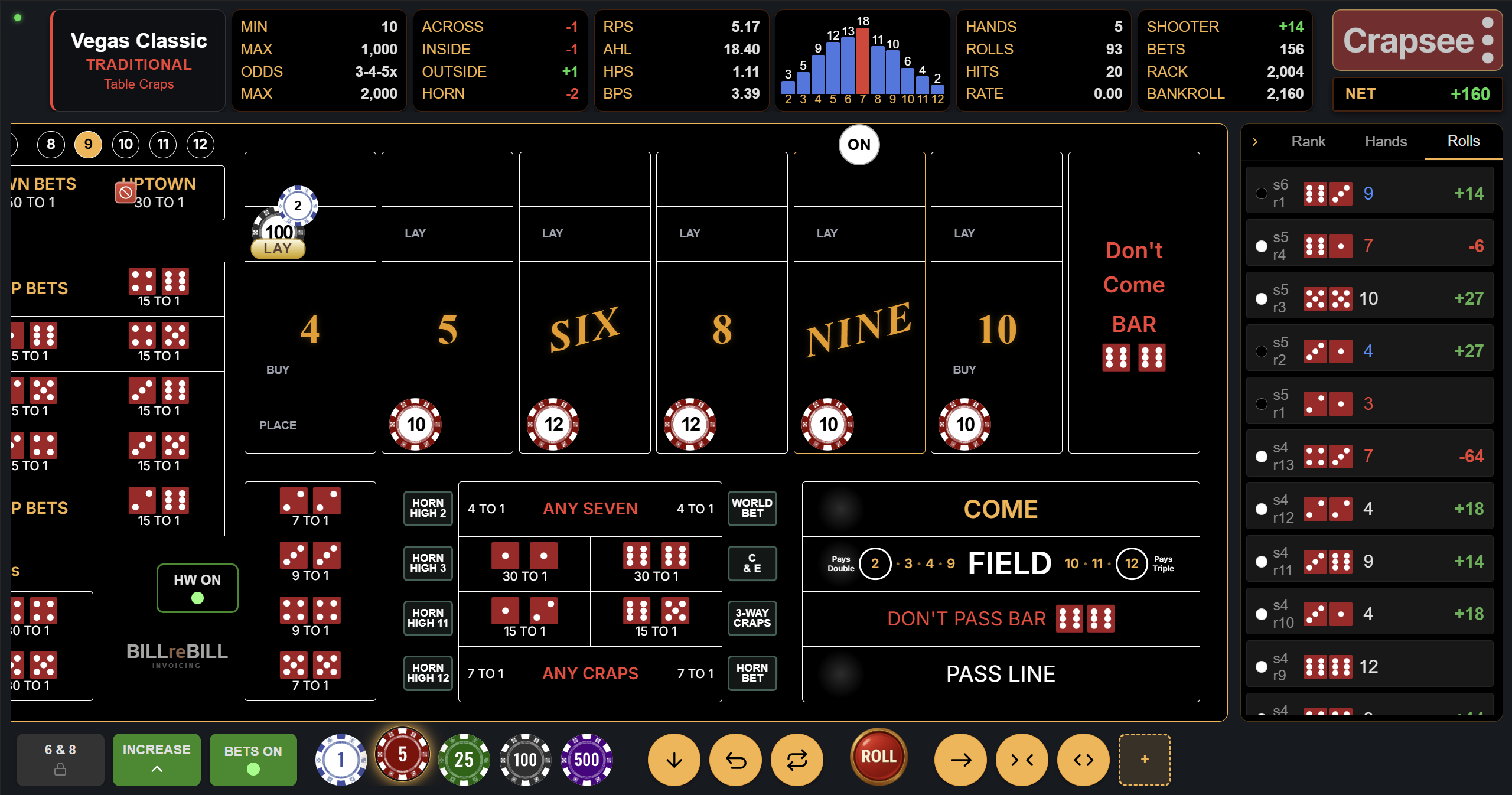
A Buy bet in craps is a wager on a specific number that pays at true odds in exchange for a 5% commission. A Lay bet is the wrong-way version: you bet that a 7 will appear before a chosen number, laying true odds and paying the same 5% vig on your potential winnings. Both bets exist because the standard all craps bets explained framework of Place betting uses discounted odds -- Buy and Lay let you access the mathematically correct odds for a price.
Practice Buy and Lay Bets Free
The fastest way to internalize Buy and Lay mechanics is to place a few bets and watch the vig calculation happen in real time. Crapsee's free craps simulator supports Buy and Lay on every point number with no signup and no real money involved. Place a Buy 4, watch it pay $39 on a $20 bet (instead of $36 for Place 4), and the math becomes intuitive immediately.
The simulator uses the browser's cryptographic random number generator for dice rolls. Every bet settlement -- including vig deductions and true odds payouts -- mirrors what you would see at a live table. Practice here until the vig math is automatic, then take it to a real table confident.
The 60-second version
- Buy bet: bet on a number, pay 5% vig, get paid at true odds when it hits. Buy 4/10 only -- it's the only number where this beats a Place bet.
- Lay bet: bet that 7 hits before your number, lay true odds (risk more to win less), pay 5% vig on your winnings. Used by wrong-way (Don't) bettors wanting instant number coverage.
- Vig math: $1 per $20 wagered, rounded down. On a $25 Buy 4 you still pay $1 (not $1.25). Most casinos round to the nearest dollar below.
- When Buy beats Place: Buy 4/10 at vig-on-win casinos (1.67% edge vs 6.67%). Never Buy 5/9 or 6/8 -- Place is better on those numbers.
- Ask the dealer: "Is vig paid on win only?" One question determines whether Buy 4/10 is a good play at this particular table.
What is a Buy bet in craps?
A Buy bet is a Place-style wager on one of the six point numbers (4, 5, 6, 8, 9, or 10) that pays at true odds instead of the slightly worse odds the casino uses for standard Place bets. To buy those true odds, you pay a 5% commission called the vig (vigorish).
Here is how it works in practice. Say you want $20 on the 4. You have two options:
- Place 4: $20 bet, pays 9-to-5 if 4 hits before 7. Win = $36. No commission.
- Buy 4: $20 bet + $1 vig, pays 2-to-1 (true odds) if 4 hits before 7. Win = $40 minus $1 vig = $39.
The Buy 4 nets $39 vs $36 for Place 4 -- $3 more per win. That difference is why Buy 4 (and Buy 10, which uses the same 2-to-1 true odds) exists as a legitimate strategic tool.
How to place a Buy bet
At a live craps table, toss your chips to the dealer and say "Buy the 4 for $20." The dealer places your chips on the 4 in the Place area with a BUY lammer (a small button marked BUY) on top to distinguish it from a plain Place bet. At vig-on-win tables, the dealer may also keep a small vig chip nearby to collect when the bet wins.
At a bubble machine or simulator, tap the Buy button for the number you want. The vig is calculated automatically.
True odds for each number
True odds reflect the actual probability of rolling a number before a 7:
| Number | Ways to make it | Ways to make 7 | True odds (against) |
|---|---|---|---|
| 4 or 10 | 3 | 6 | 2 to 1 |
| 5 or 9 | 4 | 6 | 3 to 2 |
| 6 or 8 | 5 | 6 | 6 to 5 |
Buy bets pay these exact ratios before the vig deduction. See the full craps odds and payouts chart for every bet on the table.
What is a Lay bet in craps?
A Lay bet is the wrong-way mirror of a Buy bet. Instead of betting that a specific number hits before a 7, you bet that a 7 hits before that number. You are on the same side as the Don't bettor -- rooting for the 7 to end the shooter's roll.
Because 7 is more likely to appear than any single point number, you are on the favored side of the bet. The casino compensates by requiring you to lay the true odds -- meaning you risk the larger amount to win the smaller amount. You also pay a 5% vig on your potential winnings (not your full wager).
Lay bet example: Lay the 4
True odds that 7 appears before 4: 2 to 1 in your favor. So to win $20, you must risk $40.
- You lay $40 on the 4
- Vig: 5% of your $20 potential win = $1
- If 7 comes before 4: you win $20, pay $1 vig, net = $19
- If 4 comes before 7: you lose $40
The asymmetry (risk $40, net win $19) is the price of being on the correct side of the probability. The house edge on Lay 4 at vig-on-win tables is 1.67% -- competitive with the best non-odds bets on the table.
Where Lay bets sit on the layout
Lay bets are placed by the dealer in the Don't Come box for the corresponding number, marked with a LAY button to distinguish them from active Don't Come bets. On older layouts you may see them in a separate "Don't" box behind the point numbers. At a bubble machine or simulator, there is typically a dedicated Lay button for each number.
Lay bets are always working
Unlike Place bets (which are OFF on the come-out roll by default), Lay bets are always working, including on the come-out. If a 7 rolls on the come-out, your Lay bet wins. This makes Lay bets useful for wrong-way players who want coverage across multiple numbers simultaneously without waiting for point establishment.
The 5% vig explained
The vig (vigorish, also called "juice" or commission) is the casino's fee for giving you true odds. The standard rate is 5%, calculated as $1 for every $20, rounded down to the nearest dollar at most casinos.
Vig calculation examples
| Buy bet amount | Vig (5%, rounded down) | Total to put out |
|---|---|---|
| $20 | $1 | $21 |
| $25 | $1 (rounds down from $1.25) | $26 |
| $40 | $2 | $42 |
| $100 | $5 | $105 |
The rounding convention matters. A $25 Buy 4 carries only $1 vig (not $1.25), which means the effective vig rate on a $25 bet is actually 4% rather than 5%. At $20 bets it is exactly 5%. At amounts between multiples of $20, the rounded-down vig is slightly more favorable to the player.
Vig on Lay bets
For Lay bets, the 5% vig is calculated on your potential win (the smaller number), not your total risk. Lay 4 with $40 at risk wins $20 -- vig is 5% of $20 = $1. This is a critical distinction: you are not paying 5% of your $40 risk, only 5% of your $20 expected win.
Why the vig exists
Without a vig, Buy and Lay bets would be 0% house edge -- purely fair bets. The casino could not sustain that. The vig converts the fair bet into a small house-favored bet while still giving players significantly better payouts than standard Place odds on the corner numbers (4 and 10).
Vig conventions: up front vs on win
The single most important question to ask before placing a Buy bet: "Is the vig paid on winning bets only, or on every bet?" The answer cuts the effective house edge roughly in half.
Vig on win (player-friendly)
At vig-on-win tables (common in Las Vegas), you only pay the commission when your Buy bet wins. If the bet loses, you lose only your wager -- no vig collected.
- Buy 4 for $20: put out $20
- Win: receive $40, dealer collects $1 vig, you net $39
- Lose: lose $20, no vig
- House edge: 1.67% on Buy 4/10
Vig up front (Atlantic City standard)
At vig-up-front tables, you pay the commission when placing the bet regardless of outcome.
- Buy 4 for $20: put out $21 ($20 bet + $1 vig)
- Win: receive $40 gross payout
- Lose: lose $21 total (bet + vig)
- House edge: 4.76% on Buy 4/10
At vig-up-front tables, Buy 4/10 still beats Place 4/10 (4.76% vs 6.67%), but the margin is much narrower. At vig-on-win tables, Buy 4/10 is four times better than Place 4/10. The convention is table-specific and sometimes casino-specific -- always confirm before committing chips.
How to ask
Simply tell the dealer "Buy the 4 for $20" and hand them the chips. If it is a vig-on-win table, they will take only $20. If it is vig-up-front, they will ask for $21 or tell you the total. You can also ask directly: "Is vig taken on wins only at this table?"
Buy bet payouts and house edges
The following table covers both vig conventions. All payouts assume a $20 bet for clean math.
| Number | True odds | $20 Buy wins | Edge (vig on win) | Edge (vig up front) | Place payout ($20) | Place edge |
|---|---|---|---|---|---|---|
| 4 or 10 | 2 to 1 | $39 (net) | 1.67% | 4.76% | $36 | 6.67% |
| 5 or 9 | 3 to 2 | $29 (net) | 2.00% | 4.76% | $28 | 4.00% |
| 6 or 8 | 6 to 5 | $23 (net) | 2.27% | 4.76% | $23.33 (7-to-6 on $20) | 1.52% |
The math tells a clear story:
- Buy 4/10: Best Buy bet at vig-on-win tables. At 1.67%, this is one of the lowest house edges available on any craps bet outside of Pass/Don't Pass odds.
- Buy 5/9: At vig-on-win (2.00% edge), it is slightly worse than Place 5/9 (4.00% edge)... wait, actually 2.00% is better than 4.00%. However, the dollar difference is slim: $29 net on a $20 Buy 5 vs $28 on a $20 Place 5. The $1 extra win barely justifies the added complexity for most players. Most players stick to Place 5/9 for simplicity.
- Buy 6/8: Never. Place 6/8 pays 7-to-6 on live tables (1.52% edge), beating Buy 6/8 at any vig convention. Place the 6 and 8, do not Buy them.
For a complete reference on all craps payouts and house edges, see the craps odds and payouts chart.
Lay bet payouts and house edges
Lay bets pay the smaller side of true odds -- you risk more to win less because you are on the favored (more likely) side of the bet. Vig is on the win amount.
| Number | True odds (for player) | Risk to win $20 | Vig on $20 win | Net win | Edge (vig on win) | Edge (vig up front) |
|---|---|---|---|---|---|---|
| 4 or 10 | 1 to 2 | $40 | $1 | $19 | 1.67% | 2.44% |
| 5 or 9 | 2 to 3 | $30 | $1 | $19 | 2.00% | 3.23% |
| 6 or 8 | 5 to 6 | $24 | $1 | $19 | 2.27% | 4.00% |
Key observations:
- Lay 4/10 at vig-on-win tables (1.67%) is among the best wrong-way bets available -- comparable to Don't Pass (1.36%) without requiring a come-out roll.
- Lay 5/9 and Lay 6/8 carry higher edges as the numbers become more likely to hit before a 7. The closer a number is to 7 in probability, the less value a Lay bet provides.
- Capital efficiency is lower on Lay bets: you must tie up $40 to win $19 on Lay 4. Compare that to a Don't Come bet with lay odds, where the come-out roll is free and subsequent lay odds carry 0% edge.
Buy vs Place bets: when each wins
The Place bets guide covers the core mechanics of Place betting. This section focuses specifically on when switching from Place to Buy improves your mathematical position.
The corner numbers: Buy beats Place decisively
Place 4 and Place 10 pay 9-to-5, which is the largest deviation from true odds (2-to-1) of any Place bet. This deviation is what makes Buy 4/10 attractive:
- $20 Place 4 wins: $36
- $20 Buy 4 wins (vig on win): $39
- Difference per win: +$3 for Buy
- Place 4/10 house edge: 6.67%
- Buy 4/10 house edge (vig on win): 1.67%
Buy 4/10 is not marginally better -- it is four times better at vig-on-win tables. If you are placing the 4 or 10 at a vig-on-win casino, you are leaving money on the table by not switching to Buy.
The middle numbers: Place beats Buy
Place 5/9 pays 7-to-5. True odds for 5/9 are 3-to-2. The gap is smaller than on 4/10, and the vig erodes most of the advantage:
- $20 Place 5 wins: $28
- $20 Buy 5 wins (vig on win): $29
- Difference per win: +$1 for Buy
- Place 5/9 house edge: 4.00%
- Buy 5/9 house edge (vig on win): 2.00%
Buy 5/9 does carry a lower house edge at vig-on-win tables, but the dollar difference per win is just $1. For most players, the simplicity of a plain Place 5/9 (no vig calculation, no convention check) is worth that $1. If you are a high-roller with $100+ on 5 or 9, the 2% vs 4% edge difference is more meaningful.
The outside numbers: never Buy 6 or 8
Place 6/8 pays 7-to-6 on live tables, which is close to true odds (6-to-5) and produces a low 1.52% house edge. Buy 6/8 at a vig-on-win table nets 2.27% -- worse than just placing them. There is no scenario where buying the 6 or 8 makes mathematical sense at a live craps table.
Quick decision rule
- Always Buy 4 and 10 at vig-on-win tables.
- Consider Buying 5 and 9 only at vig-on-win tables if your bet size is $100+.
- Never Buy 6 or 8 -- Place them.
- At vig-up-front tables: the Buy 4/10 edge drops to 4.76% vs 6.67% for Place. Still better, but less compelling.
Lay vs Don't Come: wrong-way comparison
Wrong-way bettors have two main tools for getting negative action on specific numbers: Lay bets and Don't Pass bet or Don't Come bets with lay odds. Each has distinct advantages.
Lay bets: instant, targeted, costs vig
- You choose the number immediately -- no waiting for a come-out roll to establish a point.
- Useful when a shooter is mid-roll and you want to back against a specific hot number.
- Vig paid means you are starting at a disadvantage vs free lay odds behind Don't Come.
- Capital intensive: Lay 4 ties up $40 to win $19.
Don't Come with lay odds: efficient, but slower
- Don't Come has a 1.36% house edge on the come-out roll (similar to Lay 4/10's 1.67%).
- After the Don't Come point is established, you can lay odds behind it at 0% house edge.
- Combined edge with full lay odds is below 0.5% -- better than any Lay bet can achieve.
- Requires patience: you must wait for a come-out roll to establish the Don't Come point on your desired number.
When to use each
| Situation | Better choice |
|---|---|
| Want wrong-way action immediately on a specific number | Lay bet |
| Optimizing for lowest house edge over a long session | Don't Come + lay odds |
| Shooter has been rolling for a long time, specific number appears dangerous | Lay bet (no come-out exposure) |
| Playing a full Don't strategy with multiple numbers covered | Don't Come + lay odds (more efficient) |
When Buy and Lay bets make sense
Use Buy bets when
- You are at a vig-on-win table and want action on the 4 or 10. This is the clearest mathematical improvement available on any craps table.
- Your bet size is large enough that the vig math produces a clean dollar advantage. On $20 bets the advantage is $3 per win. On $100 bets it is $15 per win.
- You already have Pass Line and odds working and want a secondary wager with a lower house edge than standard Place bets on the corner numbers.
Do not use Buy bets when
- You are at a vig-up-front table and the edge difference vs Place 4/10 is not worth the friction (4.76% vs 6.67% -- still better, but narrower).
- You want to bet the 6 or 8. Place 6/8 is always better than Buy 6/8.
- Your bet amount is below $20, because most casinos require a minimum $20 Buy bet to make the $1 vig practical for both sides.
Use Lay bets when
- You want wrong-way action on a specific number immediately, without the come-out exposure of a Don't Come bet.
- You are a Don't bettor who wants to cover multiple numbers simultaneously on the right side of the probability ledger.
- At vig-on-win tables, Lay 4/10 at 1.67% is one of the best bets on the table for wrong-way players.
Do not use Lay bets when
- You want to optimize for the absolute lowest house edge -- Don't Come with free lay odds achieves below 0.5%, beating any Lay bet.
- Capital efficiency matters and you are risk-averse. Laying $40 to win $19 ties up more of your bankroll per unit of expected return than most strategies.
For the broader picture of how Buy and Lay fit into a complete session approach, see the craps strategy guide covering Pass Line odds, Don't Play, and bankroll management.
Frequently asked questions
What is a Buy bet in craps?
A Buy bet is a wager on a specific number (4, 5, 6, 8, 9, or 10) that pays at true odds instead of the reduced Place bet odds. You pay a 5% commission (the vig) for the privilege. Buy 4 pays 2-to-1 true odds -- a $20 Buy 4 wins $40 minus $1 vig for a $39 net, compared to $36 for a $20 Place 4.
What is a Lay bet in craps?
A Lay bet is the wrong-way version of a Place bet. You bet that a 7 hits before your chosen number. You lay true odds (risk the larger amount to win the smaller), and pay a 5% vig on your potential winnings. Lay 4: risk $40, win $19 net (after $1 vig). The bet is always working and wins if a 7 rolls before your number at any point.
How does the vig work in craps?
The vig is a 5% commission paid in exchange for true odds payouts. Most casinos charge $1 per $20, rounded down. A $25 Buy still carries only a $1 vig (not $1.25). Two conventions: vig on win (you only pay if the bet wins, common in Las Vegas) and vig up front (you pay when placing the bet, common in Atlantic City). Vig on win is significantly more player-friendly.
Buy vs Place bet -- which is better?
Depends on the number. Buy 4/10 at vig-on-win tables: 1.67% edge vs 6.67% for Place 4/10 -- Buy wins decisively. Buy 5/9: 2.00% vs 4.00% for Place 5/9 -- Buy is technically better but the dollar difference is $1 per $20 bet. Buy 6/8: never -- Place 6/8 at 1.52% beats Buy 6/8 at 2.27%. The rule: Buy 4/10 at vig-on-win tables, Place everything else.
When should I Buy the 4 and 10?
Any time you are at a vig-on-win table and want action on the 4 or 10. At those tables, Buy 4/10 carries a 1.67% house edge vs 6.67% for Place 4/10 -- four times better. On a $20 bet, Buy 4 nets $39 vs $36 for Place 4, a $3 advantage per win. At vig-up-front tables, Buy 4/10 is still better than Place 4/10 (4.76% vs 6.67%), but confirm the convention before placing.
Do you pay vig on a win or on every bet?
It depends on the casino. Vig-on-win casinos (common in Las Vegas) collect the commission only when you win. Vig-up-front casinos (Atlantic City standard) collect it when you place the bet regardless of outcome. Always ask before placing your Buy bet. If the dealer takes only your $20 chip, it is vig-on-win. If they ask for $21, it is vig-up-front.
What is the house edge on Buy and Lay bets?
At vig-on-win tables: Buy/Lay 4 or 10 = 1.67%, Buy/Lay 5 or 9 = 2.00%, Buy/Lay 6 or 8 = 2.27%. At vig-up-front tables: all Buy bets = 4.76%, Lay bets are slightly lower (2.44% on 4/10, 3.23% on 5/9, 4.00% on 6/8). For reference, Place 6/8 = 1.52%, Place 5/9 = 4.00%, Place 4/10 = 6.67%.
How do Lay bets compare to Don't Come bets?
Both target a 7 appearing before a specific number. Lay bets are immediate -- no come-out roll required. Don't Come bets must go through a come-out roll to establish a point, but you can then lay odds behind them at 0% house edge, achieving a combined edge below 0.5%. Don't Come with lay odds is more capital-efficient long-term. Lay bets are better when you want instant action on a specific number without come-out exposure.